
Budget Planning for Tsuen Wan Commercial Renovation — What the Numbers Actually Look Like
Budget Planning for Tsuen Wan Commercial Renovation — What the Numbers Actually Look Like
5/13/202612 min read
Budget Planning for Tsuen Wan Commercial Renovation: What the Numbers Actually Look Like
Every commercial renovation starts with a number. Sometimes it is a number the tenant has worked out carefully based on business projections and professional advice. More often, it is a rough figure based on what a friend spent last year, what a contractor quoted over the phone, or what felt like a reasonable amount to allocate without really knowing what the work involves.
In Tsuen Wan, that gap between expectation and reality can be significant. The district's commercial property stock spans a wide range of building types, ages, and conditions — from ageing walk-up tenement buildings on the older commercial streets to purpose-built industrial buildings in the Texaco Road and Chai Wan Kok area, to modern shopping mall units in developments like Tsuen Wan Plaza, City Link, and Luk Yeung Galleria. Each of these formats carries a fundamentally different cost profile for renovation, and the budget that works for one will not work for another.
The tenants and business owners who manage their renovation budgets well are not necessarily the ones who spend the least. They are the ones who understand, before they commit, what the real cost drivers are for their specific type of space in their specific part of Tsuen Wan — and who build enough contingency into their plans to absorb the surprises that almost always arise.
This post is a practical guide to budgeting for commercial renovation in Tsuen Wan. It covers the cost differences between the district's main commercial property formats, the construction challenges that are specific to this area, the hidden costs that catch tenants off guard in older buildings, and the strategies that help you keep your project on budget without cutting corners that will cost you more later.
The Cost Landscape: Industrial Buildings vs Mall Units vs Street-Level Shops
The first thing to understand about renovation costs in Tsuen Wan is that the format of the space you are renovating has a larger impact on your budget than almost any design decision you will make inside it. The cost per square foot of fitting out an industrial building unit, a shopping mall unit, and a street-level shop can vary by a factor of two or more — not because of differences in interior finishes or fixtures, but because of differences in the base condition of the space, the regulatory and management requirements you must satisfy, and the logistical constraints that govern how the work gets done.
Industrial building units in Tsuen Wan typically offer the lowest base fitout cost per square foot, for the simple reason that they start with the least. A raw industrial unit is essentially a concrete shell — bare floors, exposed ceiling, basic electrical supply, and minimal or no air conditioning. If your business can operate in a relatively utilitarian environment, such as a warehouse, a logistics operation, a workshop, or a back-office function, the renovation scope can be kept modest. Floor levelling or coating, basic partition walls, upgraded lighting, and electrical distribution may be all that is required. For these types of fitouts, costs in Tsuen Wan's industrial buildings can be kept relatively lean compared to retail or commercial office renovations elsewhere in the district.
However, the picture changes significantly if you are converting an industrial unit to a use that requires a higher standard of finish — a co-working space, a retail showroom, a studio, or a food-related operation. In these cases, you are not just fitting out a space. You are upgrading it from industrial specification to commercial or retail specification, which typically involves installing or upgrading air conditioning systems, upgrading the electrical supply capacity and distribution, installing proper ceiling systems to conceal services, upgrading flooring to a commercial standard, and in many cases, addressing fire safety and means-of-escape requirements that differ from the building's original industrial use. These upgrades can add substantial cost, and they are often underestimated by tenants who see the low base rent of an industrial unit and assume the total occupancy cost will be correspondingly low.
Mall units sit at the other end of the spectrum. The base condition of a mall unit is generally better than an industrial unit — the building provides air conditioning to the unit boundary, the electrical supply is typically adequate for retail use, and the common area infrastructure is maintained by building management. But the cost of fitting out a mall unit is driven upward by several factors that do not apply in other formats. Management-imposed design and material standards often require a higher specification of finish than the tenant might otherwise choose. Restricted working hours, typically overnight only, significantly extend the construction programme and increase labour costs. The management approval process adds time and professional fees to the project. And requirements for hoarding, dust and noise containment, and waste removal during construction add further cost that would not arise in a street-level or industrial fitout.
The net result is that a mall fitout in Tsuen Wan almost always costs more per square foot than a comparable fitout in a street-level shop, even when the interior design intent is similar. Tenants who budget for a mall fitout based on their experience with street-level or industrial spaces are likely to find themselves significantly short.
Street-level shops fall somewhere in between, with costs that vary widely depending on the age and condition of the building, the extent of facade and signage work required, and the degree of structural or services upgrading needed. In newer buildings with good base conditions, a street-level fitout can be straightforward and cost-effective. In older buildings, particularly the walk-up tenement blocks that are common in the older parts of Tsuen Wan, the cost picture can be much less predictable — which brings us to the most important budget consideration in this district.
Tsuen Wan's Common Construction Challenges
Every district in Hong Kong has its own set of construction quirks, and Tsuen Wan is no exception. Several characteristics of the district's building stock and infrastructure create renovation challenges that are not always obvious at the time of leasing but become very real once work begins.
The age of the building stock is the most significant factor. Tsuen Wan was one of Hong Kong's earlier new town developments, and a substantial portion of its commercial and mixed-use building stock dates from the 1970s and 1980s. Buildings of this era were constructed to standards and specifications that differ materially from current requirements, and decades of use, alteration, and weathering have introduced further variables. Concrete quality, structural loading capacity, waterproofing integrity, and the condition of embedded services such as electrical wiring and drainage pipes can vary enormously from one building to the next and even from one floor to the next within the same building.
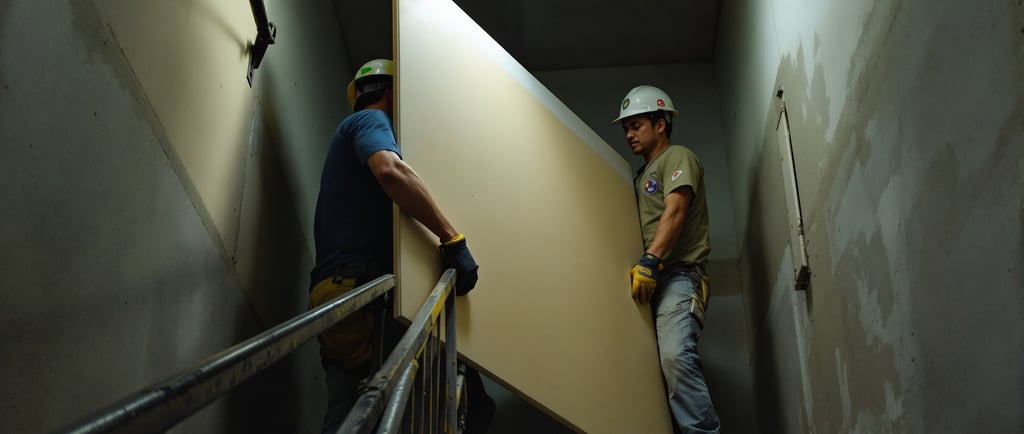
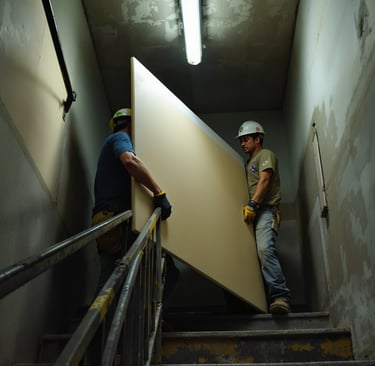
Access and logistics present another common challenge. Many of the older commercial buildings in Tsuen Wan have narrow staircases, small or slow lifts, and limited loading and unloading areas. For renovation projects that involve removing substantial quantities of demolition waste or bringing in heavy or bulky materials, the cost and time required for logistics can be materially higher than in a modern building with proper goods lift access and loading bays. In some cases, manual handling up and down staircases is the only option, and this labour-intensive approach adds directly to the project cost.
The density of the surrounding environment also plays a role. Tsuen Wan's commercial areas are busy and tightly built. Scaffolding for external facade work, skip placement for construction waste, and delivery vehicle access can all be complicated by narrow streets, heavy pedestrian and vehicle traffic, and the proximity of neighbouring buildings. These are not insurmountable problems, but they require planning and sometimes incur additional costs for traffic management, after-hours deliveries, or alternative waste removal methods.
For industrial building renovations in areas like Chai Wan Kok and the Texaco Road corridor, there is the additional consideration of the building's original construction purpose and any legacy contamination or hazardous materials issues. While this is not common, it is not unknown for older industrial buildings to have asbestos-containing materials in ceiling tiles, pipe insulation, or other building components. If asbestos is identified during renovation, the cost and regulatory requirements for its safe removal are significant, and work cannot proceed until the issue is properly addressed. A pre-renovation survey by a qualified professional is a sensible precaution for any industrial building fitout in Tsuen Wan, particularly in buildings constructed before the mid-1980s.
Hidden Costs in Old Buildings: What the Lease Does Not Tell You
If there is one area where renovation budgets in Tsuen Wan go off track most frequently, it is the discovery of problems that were not visible during the site inspection and not disclosed in the lease. Old buildings are full of surprises, and not the pleasant kind.
Electrical systems are the most common source of hidden cost. Many older commercial buildings in Tsuen Wan have electrical infrastructure that was designed for a different era of power consumption. The main supply to individual units may be inadequate for modern commercial use, particularly if the tenancy involves air conditioning, commercial kitchen equipment, server rooms, or any other high-load application. Upgrading the electrical supply to a unit is not simply a matter of installing a bigger circuit breaker. It may require upgrading the submain cable from the building's main switchboard, which in turn may require the landlord's consent, coordination with CLP Power, and potentially a contribution to the cost of upgrading the building's overall electrical capacity. These costs can be substantial and are frequently not anticipated at the budgeting stage.
Plumbing and drainage are another area where old buildings generate unexpected costs. Decades-old cast iron or galvanised steel drainage pipes may be corroded, partially blocked, or structurally compromised. If your renovation involves connecting to or relocating drainage points — as is common in food and beverage fitouts, medical or beauty clinics, and other uses that require water supply and waste disposal — the condition of the existing drainage system can have a major impact on cost. In some cases, the building's communal drainage stack may need repair or upgrading before your unit's connection can be made, and the question of who bears that cost — the landlord, the tenant, or the owners' corporation — can become a source of delay and dispute.
Waterproofing failures in older buildings can also generate significant unplanned cost, particularly for units on lower floors or basement levels. Water ingress through deteriorated waterproofing membranes, cracked external walls, or failed pipe penetrations may not be apparent during a dry-weather site inspection but can become a serious problem during Hong Kong's wet season. If your renovation exposes waterproofing deficiencies, the cost of remediation can be considerable — and the responsibility for that cost is often contested between landlord and tenant.
Structural limitations are a further consideration. Older buildings may have floor loading capacities that are lower than current standards, internal columns or beams in positions that constrain your layout options, or walls that appear to be non-structural but turn out to be load-bearing. Any renovation work that involves removing or modifying walls, cutting into floor slabs for drainage or cable routing, or imposing significant point loads from heavy equipment should be reviewed by a qualified structural engineer before work commences. The cost of a structural assessment is modest. The cost of discovering a structural problem after you have demolished a load-bearing wall is not.
Finally, there is the question of unauthorised building works carried out by previous tenants or the landlord. Older commercial buildings in Tsuen Wan frequently contain alterations — additional mezzanine floors, enclosed balconies, modified staircases, subdivided units — that were carried out without the approval of the Buildings Department. If your renovation triggers a building inspection or if you inadvertently incorporate unauthorised works into your fitout, you may find yourself responsible for rectifying the situation, even if the original works were carried out before your tenancy. This is a risk that can be mitigated by a thorough pre-lease building inspection and by ensuring that the lease clearly allocates responsibility for any pre-existing unauthorised works to the landlord.
How to Avoid Budget Overruns: Practical Strategies That Work
Given the range of cost variables and hidden risks outlined above, it might seem that renovation budget overruns in Tsuen Wan are inevitable. They are not. The tenants and business owners who consistently deliver renovation projects on budget share several common practices, and none of them involve cutting corners or hoping for the best.
The first and most important strategy is to invest in a proper pre-renovation assessment of the space before you finalise your budget. This means going beyond the standard site visit with a tape measure. It means having a qualified building surveyor or contractor inspect the condition of the floor slab, the ceiling void, the electrical supply, the drainage connections, the window and facade condition, and any areas of visible damage or deterioration. It means testing the electrical supply capacity and water pressure, not just assuming they are adequate. And it means obtaining the building's approved plans, if available, to understand the original structural layout and identify any subsequent alterations that may or may not have been authorised.
The cost of this assessment is typically a small fraction of the overall renovation budget, but the information it provides is invaluable. It allows you to build a budget based on the actual condition of the space rather than assumptions, and it identifies the areas where contingency should be concentrated.
The second strategy is to set a realistic contingency allowance and protect it. The standard advice for renovation contingency is ten to fifteen percent of the total budget. For older buildings in Tsuen Wan, fifteen to twenty percent is more realistic, reflecting the higher probability of discovering hidden problems once demolition and strip-out work begins. The contingency should be a genuine reserve, not a wish list of nice-to-have additions that will be funded if money is left over. Its purpose is to absorb unforeseeable costs without requiring you to compromise on the essential elements of the fitout.
The third strategy is to get the scope of work right before you get prices. Renovation budget overruns are most commonly caused not by price increases during the project but by scope changes — additions, modifications, and upgrades that were not included in the original brief but are added once work is underway. Every change made during construction is more expensive than it would have been if included in the original scope, because it involves redesign, rework, and disruption to the construction sequence. The more thoroughly you define the scope of work before you invite quotations, the more accurate those quotations will be and the less likely you are to face costly variations during the project.
The fourth strategy is to choose the right contractor for the type of project you are undertaking. A contractor who specialises in mall fitouts will understand the management approval process, the overnight working regime, and the hoarding and containment requirements that drive cost and timeline in that environment. A contractor who has extensive experience with industrial building conversions will know how to handle electrical upgrades, drainage modifications, and structural assessments efficiently. A contractor with a strong track record in old building renovations will be alert to the hidden cost risks described above and will price them realistically rather than ignoring them and hitting you with variation claims later. The cheapest quotation is not always the best value if it comes from a contractor who does not understand the specific challenges of your project type and location.
The fifth strategy is to align your renovation budget with your lease terms. The rent-free period negotiated in your lease is not just a financial benefit — it is the window within which your renovation must be completed before you start paying rent on a non-operational space. If your renovation takes longer than the rent-free period, every additional day is dead rent — money going out with no revenue coming in. This means your renovation timeline and your budget are directly linked to your lease negotiation, and both should be discussed in the same conversation, not treated as separate workstreams.
What a Realistic Budget Framework Looks Like
It would be misleading to publish specific dollar figures for renovation costs in Tsuen Wan, because the variables across different building types, unit conditions, and business requirements are too wide to summarise in a single number. But it is possible to outline the relative cost profile of different renovation scenarios to help you calibrate your expectations.
At the lower end of the spectrum, a basic fitout of a clean-condition industrial unit for warehouse, storage, or simple office use — involving floor treatment, basic partitioning, lighting upgrade, and electrical distribution — represents the most cost-effective renovation scenario in Tsuen Wan. The scope is limited, the building management requirements are minimal, and the logistics are generally straightforward.
In the middle range, a street-level shop fitout in a building of reasonable condition — involving facade and signage work, full interior fitout including flooring, ceiling, lighting, and air conditioning, plus electrical and plumbing works — represents a moderate investment that varies primarily with the size of the unit and the standard of finish required. The key cost variables are the extent of facade work needed and the condition of the existing building services.
At the higher end, a full fitout of a mall unit — involving management-compliant design, overnight-only construction, hoarding, high-specification finishes, and integrated signage — represents the most cost-intensive scenario on a per-square-foot basis, driven primarily by the extended construction programme and the management-imposed requirements rather than by the interior specification alone.
And the scenario that is most difficult to budget accurately is the renovation of a unit in an older building with unknown condition issues — where the apparent scope of work may be moderate but the risk of discovering hidden problems during construction is high. This is where the pre-renovation assessment and adequate contingency allowance pay for themselves many times over.
The Real Cost of Getting the Budget Wrong
A renovation that goes significantly over budget does not just cost you extra money. It disrupts your entire business launch timeline. It burns through your rent-free period. It forces you to make compromises on finishes, fixtures, or equipment that affect the customer experience. It creates stress and friction between you, your contractor, your landlord, and your business partners. And in the worst cases, it leaves you opening with insufficient working capital because money that should have been reserved for inventory, marketing, staffing, and initial operating costs was consumed by the renovation.
The commercial property market in Tsuen Wan offers genuine opportunities for businesses that choose the right space and execute their renovation intelligently. The district's combination of competitive rents, strong transport connectivity, growing residential catchment, and diverse building stock makes it one of the more versatile commercial locations in the New Territories. But opportunity and risk live in the same building — often literally — and the budget is where they meet.
Plan the budget before you plan the design. Assess the space before you trust the asking rent. Build contingency before you build anything else. And choose your contractor with the same care you used to choose your location.
In commercial renovation, the budget is not just a number. It is a strategy. And in Tsuen Wan, getting that strategy right is the difference between a strong opening and a difficult first year.
Contact
Questions? Reach out anytime, we're here.
Phone
© 2025. All rights reserved.