
Compliance and Licensing Risks in Tsuen Wan Commercial Renovation Projects — What You Cannot Afford to Get Wrong
Compliance and Licensing Risks in Tsuen Wan Commercial Renovation Projects — What You Cannot Afford to Get Wrong
5/20/202614 min read

Introduction: The Invisible Layer of Every Renovation Project
When tenants plan a commercial renovation in Tsuen Wan, the conversation almost always begins with design, budget, and timeline. What the space will look like. How much it will cost. How quickly it can be completed. These are legitimate priorities, and they dominate the early stages of every project for obvious reasons — they are tangible, immediate, and directly connected to the business opening its doors.
But beneath every design decision, every construction activity, and every operational plan sits an invisible layer that most tenants engage with too late or not at all: compliance. The web of regulatory requirements that governs what a commercial space can be used for, how it can be modified, what licences are needed to operate, and what safety standards must be met before a single customer walks through the door.
In Hong Kong, this regulatory framework is not simple. It involves multiple government departments, each with its own jurisdiction, application processes, inspection regimes, and enforcement powers. The Buildings Department governs structural alterations and building works. The Fire Services Department sets requirements for fire safety installations and means of escape. The Food and Environmental Hygiene Department issues licences for food businesses. The Education Bureau regulates tutorial and education centres. The Lands Department controls permitted uses through lease conditions and land grants. And for industrial buildings, the regime becomes even more layered, with specific restrictions on use that many tenants either misunderstand or choose to ignore.
Tsuen Wan's commercial property market makes these compliance issues particularly acute, for three reasons. First, the district has one of the highest concentrations of industrial buildings in the New Territories, and the tension between the original industrial designation of these buildings and their current commercial and retail use creates a persistent compliance gap. Second, the age of the building stock — with a substantial proportion dating from the 1970s and 1980s — means that many buildings were constructed under earlier regulatory standards and may not meet current fire safety, structural, or building services requirements without upgrades. Third, the diversity of business types operating in the district — food and beverage, education, beauty and wellness, retail, co-working, creative studios — means that tenants are subject to a wide range of sector-specific licensing requirements, each with its own spatial, ventilation, safety, and operational conditions that must be addressed during the renovation, not after it.
This blog examines the major compliance and licensing risks that tenants face in Tsuen Wan commercial renovation projects, organised by the categories that cause the most problems in practice: industrial building use restrictions, fire safety requirements, sector-specific licensing, and the risks associated with structural modifications and unauthorised building works.
Industrial Building Use Restrictions: The Most Misunderstood Risk in Tsuen Wan
Tsuen Wan's industrial buildings are among the most popular commercial property choices in the district. The reasons are well established — lower rent per square foot compared to street-level shops and mall units, larger available floor areas, higher ceiling heights that enable mezzanine and loft configurations, and a raw aesthetic that appeals to certain business types such as studios, showrooms, and creative enterprises.
However, the popularity of industrial buildings for commercial use does not mean that such use is automatically permitted. This is the single most misunderstood compliance issue in Tsuen Wan, and it creates significant risk for tenants who proceed with a renovation and business setup without verifying the legal position.
The fundamental issue. Industrial buildings in Hong Kong are typically subject to lease conditions that restrict their use to industrial purposes — manufacturing, warehousing, and ancillary activities. These restrictions are imposed through the Government Lease or Conditions of Grant registered against the property at the Lands Department. When a tenant uses an industrial building unit for a non-industrial purpose — such as retail, food and beverage, office, education, or personal services — that use may constitute a breach of the lease conditions, regardless of whether the landlord has given consent.
The waiver system. To address the growing demand for non-industrial uses in industrial buildings, the Government has operated various policy mechanisms over the years, including temporary waivers and the revitalisation scheme for industrial buildings. A waiver granted by the Lands Department permits a specific non-industrial use in a specific unit for a defined period, subject to conditions and the payment of a waiver fee. However, not all industrial buildings in Tsuen Wan have waivers in place, and where a waiver does exist, it may cover only certain floors or certain types of use. A tenant operating a business type not covered by the existing waiver is not protected by it.
Practical implications for tenants. The compliance risk for tenants manifests in several ways. If the use is not permitted and no waiver is in place, the Government can take enforcement action, which may include issuing a warning letter, imposing a penalty, or in serious cases, requiring the cessation of the non-compliant use. Insurance coverage may also be affected — some commercial insurance policies contain exclusions for businesses operating in premises where the use is not lawfully permitted. More immediately, certain government licences and permits — particularly food business licences and places of public entertainment licences — may be difficult or impossible to obtain for premises in industrial buildings without a valid waiver or change of use.
What tenants should do. Before committing to a lease in a Tsuen Wan industrial building, tenants should conduct a due diligence check on the permitted use. This involves reviewing the Government Lease conditions, confirming whether a waiver is in place and what uses it covers, and verifying that the intended business activity falls within the permitted scope. This is not information that landlords or agents always volunteer, and tenants who rely on verbal assurances without documentary verification are accepting a risk that can undermine the entire business.
Fire Safety Compliance: The Requirement That Shapes the Renovation
Fire safety is not a peripheral consideration in a Tsuen Wan commercial renovation — it is a central design driver that affects layout, materials, construction methods, and budget. For tenants unfamiliar with Hong Kong's fire safety regulatory framework, the scope and specificity of the requirements frequently come as a surprise, often late in the renovation process when changes are most expensive.
The regulatory framework. Fire safety in commercial premises is governed primarily by the Fire Services Department under the Fire Safety (Commercial Premises) Ordinance and related regulations. The requirements cover two broad areas: fire service installations and equipment, which include items such as sprinkler systems, fire extinguishers, fire alarm systems, emergency lighting, and fire hose reels; and means of escape, which refers to the design and maintenance of escape routes from the premises to a place of safety.
Fire safety in older Tsuen Wan buildings. A significant proportion of commercial buildings in Tsuen Wan were constructed before the implementation of current fire safety standards. Many older walk-up buildings lack sprinkler systems, have narrow staircases that do not meet current width requirements for means of escape, and have fire service installations that have not been upgraded or properly maintained. When a tenant takes a unit in such a building, the building-level fire safety deficiencies become a factor in the tenant's own compliance position. The Fire Services Department may impose additional requirements on the tenant's premises to compensate for building-level shortcomings, or may raise objections during the licensing process that must be resolved before operation can commence.
Fire safety plans and licensing. For many business types in Tsuen Wan, the fire safety plan is a prerequisite for licensing. A food business licence application to the Food and Environmental Hygiene Department, for example, requires submission of a fire safety certificate or letter of compliance from the Fire Services Department. The same applies to applications for places of public entertainment licences and certain other operational permits. The fire safety plan must demonstrate that the premises, as renovated, meet the required standards for fire service installations and means of escape relevant to the specific use. This means that the renovation design must be developed with fire safety compliance in mind from the beginning — it cannot be retrofitted as an afterthought without potentially requiring significant rework.
Common fire safety issues in Tsuen Wan renovations. The problems that most frequently arise include inadequate means of escape, particularly in units where the renovation layout creates dead-end corridors or positions customer seating or workstations in areas that are too far from an exit; insufficient fire separation between the tenant's premises and adjacent units, which is a common issue in subdivided industrial buildings; the use of combustible materials in locations where fire-rated construction is required; and failure to maintain or upgrade fire service installations to the standard required for the licensed use. In industrial buildings being used for non-industrial purposes, the mismatch between the building's original fire safety provisions — designed for industrial occupancy — and the requirements for commercial or retail occupancy can be substantial.
The cost implication. Fire safety compliance is one of the most frequently underbudgeted items in Tsuen Wan commercial renovations. Upgrading or installing sprinkler systems, providing fire-rated partitions, reconfiguring escape routes, and engaging registered fire service installation contractors all carry significant costs. Tenants who discover these requirements mid-renovation face the choice of absorbing the additional cost or compromising the design to reduce the fire safety scope — the latter being an approach that risks non-compliance and its consequences.
Sector-Specific Licensing: The Requirements That Dictate the Design
Beyond the general building and fire safety regulations, tenants in Tsuen Wan face sector-specific licensing requirements that vary dramatically depending on the type of business. These licensing regimes impose spatial, structural, ventilation, hygiene, and operational conditions on the premises — conditions that must be satisfied before the licence is granted and maintained throughout the period of operation. A renovation that does not account for these requirements from the design stage will almost certainly require costly modifications later.
Food and beverage licensing. For food businesses, the Food and Environmental Hygiene Department issues several categories of licence, including the general restaurant licence, light refreshment restaurant licence, food factory licence, and various restricted food permits. Each category carries specific requirements for the premises, and these requirements go well beyond food preparation hygiene. Kitchen areas must typically be enclosed with fire-rated construction and provided with mechanical ventilation and grease trap connections. Wash-hand basins must be positioned at specified locations. Floor finishes in food preparation areas must be non-slip, impervious, and capable of being effectively cleaned. Ceiling heights in kitchen areas must meet minimum standards. The separation between customer seating and food preparation zones must comply with prescribed arrangements.
In Tsuen Wan, food and beverage licensing is particularly challenging in two common scenarios. The first is street-level shops in older walk-up buildings, where the existing drainage infrastructure may not support the grease trap and waste water discharge requirements for a food licence, and where the ventilation provisions for mechanical exhaust may conflict with building management requirements or the proximity of upper-floor residential units. The second is industrial building units, where the permitted use question intersects with the licensing question — the Food and Environmental Hygiene Department may decline to process a food business licence application for premises where the use is not permitted under the Government Lease conditions.
Education and tutorial centre licensing. Tutorial centres and education-related businesses in Hong Kong are regulated by the Education Bureau under the Education Ordinance. Premises used for providing education to more than a specified number of persons at any one time must be registered as a school or exempted from registration. The registration process requires the premises to satisfy conditions relating to classroom size per student, means of escape, fire safety provisions, structural safety, ventilation, and sanitary facilities. In Tsuen Wan, where tutorial centres are a common business type in both commercial buildings and industrial buildings, the licensing requirements impose significant constraints on the renovation design — particularly regarding the width and number of escape routes, the fire rating of partition walls between classrooms, and the provision of toilet facilities.
Beauty, wellness, and personal services. Businesses providing beauty treatments, massage services, and personal care in Tsuen Wan are subject to regulatory requirements that have become more defined in recent years. Depending on the specific services offered, the premises may need to satisfy requirements relating to hygiene standards, ventilation, the separation of treatment areas, and the qualifications of practitioners. For businesses operating in industrial buildings, the permitted use issue again becomes relevant, as personal services may not fall within the scope of an existing waiver.
The design-first trap. The most common mistake tenants make with sector-specific licensing is treating it as an administrative task to be completed after the renovation is finished. In practice, the licensing requirements are design requirements — they dictate the position of walls, the specification of finishes, the routing of drainage, the capacity of ventilation systems, and the configuration of escape routes. A renovation completed without reference to the licensing conditions is a renovation that may need to be partially demolished and rebuilt to achieve compliance. This is not a theoretical risk — it is a scenario that occurs with regularity in Tsuen Wan, particularly among first-time business operators who underestimate the specificity of Hong Kong's licensing regimes.
Structural Modifications and Unauthorised Building Works: The Hidden Liability
Commercial renovations in Tsuen Wan routinely involve physical modifications to the premises — removing or relocating partition walls, creating new openings, installing mezzanine levels, modifying floor levels, and altering drainage or plumbing routes. Many of these modifications are straightforward and fall within the scope of works that a tenant can carry out without specific government approval. But some modifications cross a threshold that triggers the building works approval process under the Buildings Ordinance — and the consequences of getting this wrong are severe.
What constitutes building works. Under the Buildings Ordinance, building works include any works that involve the structure of a building, the external walls, the fire resisting construction, or the drainage system. Removing or altering a structural wall, creating an opening in a load-bearing element, constructing a mezzanine floor, and modifying the building's drainage system are all examples of works that may require prior approval from the Buildings Department through the submission of plans by an Authorised Person.
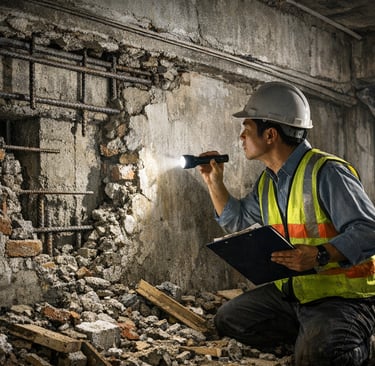
The structural wall question. In older Tsuen Wan buildings, the distinction between a structural wall and a non-structural partition is not always obvious to the untrained eye. Many buildings from the 1970s and 1980s use a combination of reinforced concrete structural frames and masonry infill walls. Some of these masonry walls are non-structural partitions that can be removed without affecting the building's stability. Others are load-bearing or contribute to the lateral stability of the structure, and their removal can have serious safety implications. Tenants who instruct their renovation contractor to remove a wall without first obtaining a professional assessment of its structural function are accepting a risk that extends beyond regulatory non-compliance to physical safety.
Unauthorised building works. Works carried out without the required approval constitute unauthorised building works, commonly referred to as illegal structures. The Buildings Department maintains an active enforcement programme against unauthorised building works and can issue removal orders requiring the owner or occupier to reinstate the premises to their original condition at their own cost. For tenants, the risk is twofold. First, carrying out unauthorised works during a renovation creates direct liability. Second, inheriting unauthorised works from a previous tenant — such as an unapproved mezzanine, a removed structural wall, or an enclosed balcony — creates liability for the current occupier if the Buildings Department takes enforcement action.
The Tsuen Wan context. The age of Tsuen Wan's commercial building stock makes this issue particularly prevalent. Decades of successive tenancies, each carrying out modifications without necessarily obtaining approval or reinstating the premises at the end of the lease, have resulted in many units containing accumulated unauthorised works. A tenant taking on a unit that appears to have been renovated by a previous occupier should not assume that those works were properly approved. A pre-renovation survey by a qualified building professional can identify existing unauthorised works and assess the structural implications of any proposed modifications — an investment that is modest compared to the cost of a Buildings Department removal order.
Drainage modifications. Alterations to the building's drainage system are a particularly common trigger for compliance issues in Tsuen Wan renovations, especially for food and beverage businesses that require new drainage connections for kitchen sinks, grease traps, and wash-hand basins. In older buildings, connecting new drainage to an aged and potentially corroded drainage stack carries both a regulatory risk — the works may require approval — and a practical risk — the existing drainage system may not have the capacity or condition to support additional connections without failure.
The Compliance Timeline: When Each Requirement Must Be Addressed
One of the most damaging misconceptions in commercial renovation projects is that compliance can be addressed sequentially — first design the space, then build it, then apply for licences and deal with any compliance issues that arise. In reality, the compliance requirements must be integrated into the project from the very beginning, because they influence decisions at every stage.
Before signing the lease. The permitted use of the premises under the Government Lease should be verified. For industrial buildings, the existence and scope of any waiver should be confirmed. The building's fire safety status should be investigated — whether it is subject to any outstanding fire safety improvement orders, and whether the existing fire service installations are adequate for the intended use. The feasibility of obtaining the required sector-specific licences for the particular premises should be assessed in principle, not assumed.
During the design phase. The renovation design must be developed with full knowledge of the licensing requirements for the intended business type. The fire safety plan should be prepared concurrently with the interior design, not after it. Any proposed structural modifications should be reviewed by a qualified professional to determine whether Buildings Department approval is required. The drainage design should account for both the regulatory approval process and the physical condition of the existing drainage infrastructure.
During construction. Works that require approval must not commence until approval has been obtained. Fire service installations must be carried out by registered contractors. Materials and construction methods must comply with the specifications required for fire safety and licensing compliance. Any unexpected conditions discovered during construction — such as previously concealed unauthorised works or structural deficiencies — must be addressed before work continues.
Before opening for business. All required licences and permits must be obtained before the business commences operation. Fire safety certificates or compliance letters must be in hand. Inspections by the relevant government departments must be completed and passed. Operating without the required licences exposes the business to enforcement action, fines, and in some cases, closure orders that can be issued without prior notice.
This timeline is not optional, and it is not flexible. Tenants who compress it — by starting construction before confirming the permitted use, or by applying for licences after the renovation is complete — consistently encounter problems that are more expensive to resolve retroactively than they would have been to address proactively.
The Cost of Getting It Wrong
The consequences of non-compliance in a Tsuen Wan commercial renovation are not abstract. They are specific, quantifiable, and in some cases, terminal to the business.
Financial consequences. Rectification works to achieve compliance after a renovation is complete can cost a significant fraction of the original renovation budget. Removing and rebuilding a wall that was found to be structural. Installing a sprinkler system that was not included in the original design. Reconfiguring a kitchen layout to satisfy food licensing requirements. Each of these scenarios involves demolishing finished work and rebuilding to a different specification — the most expensive possible way to carry out construction. Add to this the professional fees for Authorised Persons, registered structural engineers, and fire safety consultants that should have been engaged from the beginning, and the cost of non-compliance can approach or exceed the cost of a compliant renovation.
Time consequences. Licensing delays caused by non-compliant premises directly affect the business's revenue timeline. Every week that a licence application is delayed because the premises fail an inspection or require modifications is a week of rent paid without revenue earned. In Tsuen Wan, where many tenants negotiate rent-free periods specifically to cover the renovation and licensing period, delays that push the opening date beyond the rent-free period result in dead rent — a direct and unrecoverable cost.
Operational consequences. Operating without the required licences is not a sustainable strategy. Enforcement by the Food and Environmental Hygiene Department, the Fire Services Department, or the Buildings Department can result in closure notices, prosecution, and fines. The reputational damage of a publicised enforcement action — or worse, a safety incident in premises that did not meet the required standards — can be catastrophic for a small business.
Conclusion: Compliance Is Not a Cost — It Is the Foundation
For tenants planning a commercial renovation in Tsuen Wan, compliance and licensing should not be viewed as bureaucratic overhead or as an obstacle to getting the business open quickly. They are the structural foundation upon which the business operates legally, safely, and sustainably.
The regulatory landscape in Hong Kong is complex, and Tsuen Wan's specific conditions — the prevalence of industrial buildings with use restrictions, the age of the building stock and its implications for fire safety and structural integrity, and the diversity of business types with their varied licensing requirements — add layers of complexity that tenants in newer or more homogeneous districts may not encounter.
The tenants who navigate this successfully share a common approach. They treat compliance as a design input, not a post-construction checklist. They engage qualified professionals — Authorised Persons, registered structural engineers, fire safety consultants, licensing advisors — early in the process rather than after problems emerge. They verify the permitted use and licensing feasibility of a premises before committing to a lease, not after signing. And they build realistic time and cost allowances for the compliance process into their project budget and timeline from the outset.
None of this is complicated in principle. But it requires discipline, professional guidance, and a willingness to address unglamorous regulatory questions before moving on to the more exciting work of design and construction. In Tsuen Wan's commercial property market, the businesses that last are not always the ones with the best location or the most impressive fitout. They are the ones that got the compliance right from the beginning.
Contact
Questions? Reach out anytime, we're here.
Phone
© 2025. All rights reserved.