Converting Industrial Units in Kwun Tong: Structural & Compliance Challenges 觀塘工廈改造:結構與合規風險全解析
Converting Industrial Units in Kwun Tong: Structural & Compliance Challenges 觀塘工廈改造:結構與合規風險全解析
6/16/20263 min read
Converting Industrial Units in Kwun Tong: Structural & Compliance Challenges
觀塘工廈改造:結構與合規風險全解析
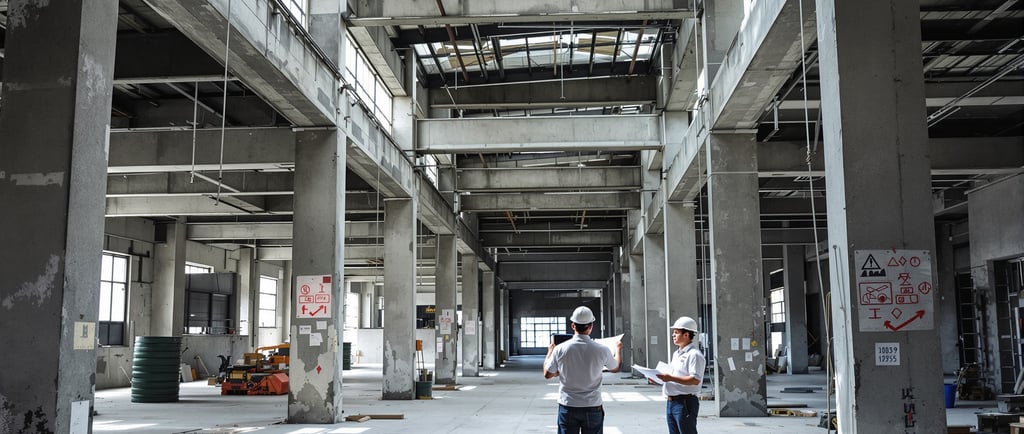
Kwun Tong has become one of Hong Kong’s most active industrial-to-commercial conversion zones.
From fitness studios and dance centres to tutorial schools and upstairs restaurants, industrial units are constantly being transformed into modern business spaces.
However, behind every successful conversion lies a series of structural and compliance challenges that are often underestimated.
Industrial buildings were never originally designed for today’s commercial activities.
Before signing a lease — or starting renovation — it is critical to understand the technical realities.
1️⃣ Load-Bearing Walls: What Cannot Be Removed
One of the most common misconceptions in industrial renovation is assuming the layout is fully flexible.
While industrial units often appear open-plan, many older buildings contain:
Structural shear walls
Load-bearing columns
Thick reinforced concrete cores
Transfer beams
Removing or altering these elements without structural assessment is not just risky — it is illegal.
Even drilling large openings for doors or combining adjacent units may require:
Structural engineer verification
Calculation of load redistribution
Approval under building regulations
In Kwun Tong, many buildings were constructed between the 1960s–1980s, meaning structural systems may not align with modern expectations.
Design must work with the structure — not against it.
2️⃣ Floor Loading Limitations
Industrial buildings are generally designed for heavier loading compared to office buildings.
However, this does not mean unlimited capacity.
Floor loading must be carefully assessed for:
Gym equipment
Dance studios
Storage racking systems
Commercial kitchen equipment
Water tanks
Dense partition layouts
Common oversight:
Tenants assume “industrial” equals safe for all heavy equipment.
In reality, floor loading is specified in kPa (kilopascals), and concentrated loads may exceed allowable limits even if overall average load seems acceptable.
For example:
Free weight zones
Heavy machinery
Raised platforms
Without proper structural calculation, excessive loading may cause:
Long-term slab deflection
Cracking
Waterproofing failure
Structural risk
Professional assessment should always precede equipment installation.
3️⃣ Electrical Capacity Constraints
Older industrial buildings in Kwun Tong were designed for manufacturing operations — but not necessarily modern lifestyle businesses.
Many converted units face:
Insufficient three-phase power supply
Limited transformer capacity
Shared building electrical infrastructure
Outdated distribution boards
Businesses commonly affected:
Fitness centres (multiple treadmills & AC systems)
F&B operators (heavy kitchen equipment)
Tutorial centres (high air-conditioning load)
Beauty academies (high plug load density)
Upgrading electrical capacity may require:
Application to power company
Transformer upgrade
Main switchboard replacement
Cable riser assessment
These upgrades can significantly impact budget and timeline.
Rental may be affordable — but electrical upgrade cost can surprise new operators.
4️⃣ Fire Safety Compliance
Fire services compliance is one of the most sensitive aspects of industrial conversion.
Key considerations include:
Means of escape distance
Fire-rated partitions
Smoke lobby requirements
Sprinkler coverage
Fire service installations (FSI) modification
Subdividing units or changing internal layouts may:
Alter escape routes
Reduce corridor width
Affect fire compartmentation
For education centres or F&B operations, additional licensing requirements apply.
Many renovation delays in Kwun Tong are caused not by design — but by fire compliance revision and resubmission.
Early consultation with fire engineers can prevent costly rework.
5️⃣ Usage & Licensing Risks
Perhaps the most overlooked issue is usage classification.
Not all commercial activities are permitted within industrial buildings.
Key risk areas:
Restaurants requiring food factory or restaurant license
Education centres requiring specific approval
Assembly-type activities with high occupant load
Retail operations exceeding permitted usage
Industrial buildings are subject to planning and land lease conditions.
Operating beyond permitted usage can result in:
Enforcement action
Licensing rejection
Insurance complications
Mandatory reinstatement
Before investing in renovation, business owners should clarify:
What is the permitted user under the lease?
Does the intended operation require government approval?
Will layout affect licensing feasibility?
Compliance must be evaluated at planning stage — not after renovation.
6️⃣ Why Early Technical Assessment Matters
In Kwun Tong, many businesses are attracted by:
Lower rental rates
Larger floor areas
Flexible industrial layout
However, successful conversion requires integrating:
Structural feasibility
Electrical capacity
Fire services strategy
Usage compliance
Cost planning
Industrial conversion is not cosmetic renovation.
It is a technical repositioning process.
The difference between a smooth project and a problematic one often lies in early-stage due diligence.
Conclusion: Opportunity With Responsibility
Kwun Tong remains one of the most opportunity-rich industrial-commercial districts in Hong Kong.
But opportunity must be balanced with technical responsibility.
Before committing to a unit, business owners should evaluate:
✔ Structural constraints
✔ Floor loading capacity
✔ Electrical infrastructure
✔ Fire safety compliance
✔ Usage legality
When properly assessed and strategically planned, industrial units can be successfully transformed into high-performing commercial spaces.
Without that foundation, risk accumulates quickly.
In industrial conversion, knowledge is not optional — it is protection.
Contact
Questions? Reach out anytime, we're here.
Phone
© 2025. All rights reserved.