
Designing Retail Spaces That Increase Customer Dwell Time
Designing Retail Spaces That Increase Customer Dwell Time
3/4/20262 min read
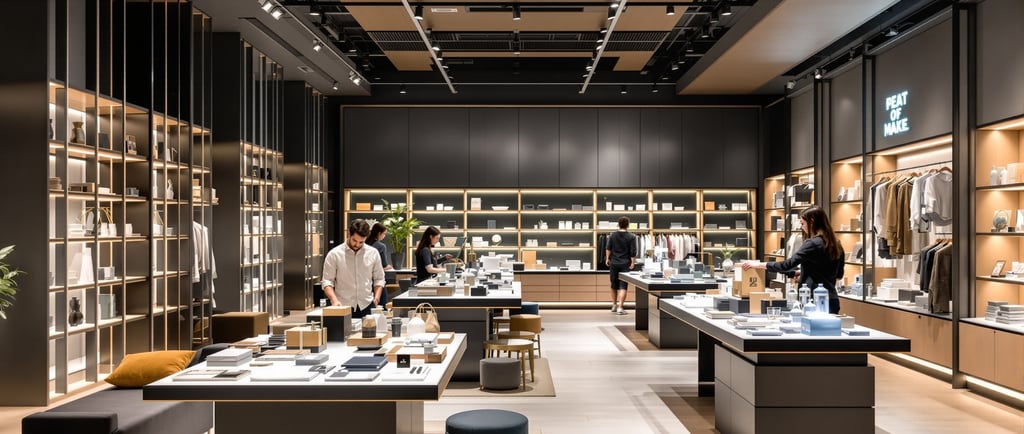
Designing Retail Spaces That Increase Customer Dwell Time
In retail environments, time equals opportunity.
The longer customers stay in a store, the higher the likelihood of engagement, product interaction, and ultimately purchase. While pricing and product quality are important, spatial design plays a critical role in influencing customer dwell time.
Through strategic lighting, merchandising, and spatial planning, retailers can create environments that naturally encourage customers to slow down, explore, and stay longer.
1. Lighting Atmosphere: Setting the Emotional Tone
Lighting is one of the most powerful tools in retail design. It directly affects mood, perception of quality, and browsing comfort.
Effective retail lighting should include:
Layered lighting (ambient, accent, and task lighting)
Highlighting feature products with focused spotlights
Warm or neutral tones that create comfort
Avoiding overly harsh or flat illumination
Bright, evenly distributed lighting may support visibility, but without contrast and focal emphasis, it can feel clinical and uninviting.
Accent lighting draws attention to key merchandise and creates visual pauses. These pauses naturally slow customer movement and increase dwell time.
Lighting is not just functional—it shapes emotional experience.
2. Strategic Visual Merchandising
Merchandising is not simply about displaying products—it is about guiding customer curiosity.
Well‑planned retail layouts that encourage longer browsing often include:
Clear product zoning
Feature tables or “hero” displays
Eye‑level product placement
Layered presentation (foreground, midground, background)
Overcrowded shelves reduce clarity and overwhelm shoppers. When products are displayed with breathing space, customers feel more comfortable examining them.
Strategic focal points placed throughout the store create reasons to pause and explore further. These moments increase product interaction and support higher conversion rates.
3. Comfort and Spatial Proportion
Customers are more likely to stay in environments that feel comfortable and easy to navigate.
Important considerations include:
Appropriate aisle widths
Clear circulation paths
Avoiding congestion points
Balanced ceiling height and spatial scale
If customers feel rushed, crowded, or physically restricted, they are more likely to leave quickly.
Seating areas, fitting rooms with adequate space, and thoughtful transitions between zones can significantly improve dwell time.
Comfort directly influences purchase behaviour.
4. Creating Zones for Discovery
Retail spaces that increase dwell time often create micro‑experiences within the store.
Examples include:
Lifestyle corners
New arrival sections
Seasonal feature areas
Interactive display zones
Zoning breaks monotony and creates a sense of exploration. Instead of walking straight through, customers are encouraged to move deeper into the space.
When store planning integrates experiential elements, customers shift from transactional browsing to immersive engagement.
5. Sensory Balance and Atmosphere
Beyond lighting and layout, overall atmosphere influences how long customers remain inside a store.
Key factors include:
Balanced background music
Controlled temperature and ventilation
Visual consistency in materials and colour palette
An environment that feels cohesive and comfortable encourages relaxed browsing. When customers feel at ease, they are more open to spontaneous purchasing decisions.
6. Aligning Dwell Strategy with Brand Identity
Not all brands require the same dwell strategy.
Luxury retailers may prioritise spacious layouts and slower browsing experiences
Fast‑fashion brands may encourage quicker circulation with frequent focal highlights
Lifestyle brands may integrate experiential zones to build emotional connection
Retail design should reflect brand positioning while supporting sales objectives.
Conclusion
Designing retail spaces that increase customer dwell time is a strategic process, not an aesthetic decision.
Through effective lighting design, thoughtful merchandising strategies, and comfortable spatial planning, retailers can create environments that naturally encourage customers to stay longer and engage more deeply.
Longer dwell time leads to stronger emotional connection, increased product interaction, and improved sales performance.
A well‑designed retail space does not force customers to stay—it gives them a reason to.
Contact
Questions? Reach out anytime, we're here.
Phone
© 2025. All rights reserved.