
How Retail Store Layout Influences Customer Buying Behaviour
How Retail Store Layout Influences Customer Buying Behaviour
RETAIL
3/3/20263 min read
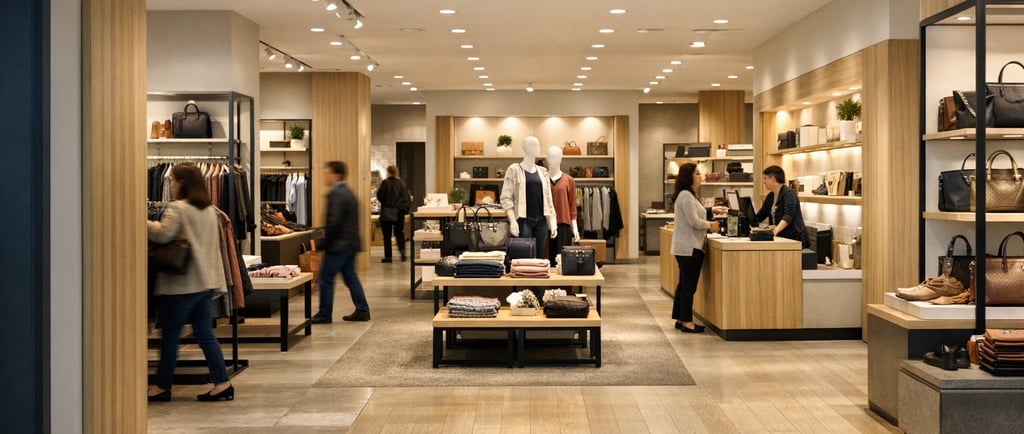
How Retail Store Layout Influences Customer Buying Behaviour
In retail, sales are not driven by products alone. The physical environment plays a powerful role in influencing how customers move, browse, and ultimately decide to purchase. A well‑planned retail layout does more than organise merchandise—it shapes behaviour.
Understanding how retail layout and store planning affect buying behaviour allows store owners to design spaces that naturally guide customers toward higher engagement and better conversion.
1. The Entrance Experience: Setting the Direction
The customer journey begins at the entrance. Within the first few seconds, shoppers form impressions about the brand, price positioning, and overall quality.
Effective entrance design should:
Create a clear and welcoming pathway
Avoid clutter that overwhelms customers
Highlight key products or promotions
Encourage movement deeper into the store
Research shows that most customers instinctively turn right upon entering. Strategic store planning places high‑margin or promotional items along this primary circulation path to increase exposure.
The entrance is not just a doorway—it is the starting point of behavioural flow.
2. Main Circulation Path: Guiding Customer Movement
Retail store layout determines how customers move through the space. Without clear circulation, customers may feel disoriented or skip important product areas.
Common retail layout strategies include:
Loop layout (racetrack design) – guides customers along a defined path
Free‑flow layout – encourages exploration in boutique environments
Grid layout – efficient for supermarkets and high‑volume retail
The goal of effective store planning is to balance guidance with freedom. Customers should feel in control while still being subtly directed through product zones.
A logical pathway increases product exposure and maximises sales opportunities.
3. Dwell Time and Sales Conversion
The longer customers stay in a store, the higher the likelihood of purchase. Retail layout directly influences dwell time through:
Clear zoning and product grouping
Comfortable aisle widths
Strategic placement of feature displays
Proper lighting to highlight merchandise
Bottlenecks, narrow pathways, or poorly positioned displays can reduce comfort and shorten browsing time.
Design should encourage natural pauses—whether through feature tables, focal displays, or experiential corners. These moments increase interaction and improve sales conversion rates.
4. Visual Focal Points: Directing Attention Strategically
Human attention is guided by contrast, lighting, and spatial emphasis. Effective visual focal points within a retail store layout can significantly influence buying decisions.
Key focal design strategies include:
Highlight walls behind key products
Spotlighting new arrivals
Symmetrical display arrangements
Framing hero products at eye level
Customers rarely scan an entire store equally. Strategic visual hierarchy ensures priority products receive maximum attention.
Well‑planned store layouts reduce decision fatigue by organising products clearly and guiding visual flow.
5. The Role of Checkout Placement
Checkout counters should be visible yet not intrusive. Poor placement can interrupt circulation or create congestion.
An effective store planning strategy positions the checkout:
Along the natural exit path
Within visual awareness throughout the store
With surrounding impulse purchase opportunities
Impulse items placed near checkout areas often increase average transaction value.
6. Aligning Layout with Brand Positioning
Retail layout should reflect brand identity.
For example:
Luxury brands benefit from spacious layouts and clear product breathing space
Fast‑fashion retailers may prioritise density and product variety
Lifestyle brands may integrate experiential zones
Store planning must support how customers are expected to interact with the brand.
Layout is not only functional—it communicates value perception.
7. Common Retail Layout Mistakes
Many retailers underestimate the impact of layout decisions. Common mistakes include:
Overcrowding merchandise
Ignoring natural customer movement patterns
Placing high‑margin items in low‑visibility zones
Failing to plan for future reconfiguration
Professional retail layout planning helps avoid these issues and ensures long‑term usability.
Conclusion
Retail store layout is a strategic business tool. From entrance design to circulation planning and visual focal points, every spatial decision influences how customers move, engage, and purchase.
Effective retail layout and store planning are not simply about aesthetics—they are about behavioural strategy.
By designing spaces that guide movement, extend dwell time, and highlight key products, retailers can create environments that naturally support stronger sales performance.
A well‑planned store does not push customers to buy—it makes buying feel effortless.
Contact
Questions? Reach out anytime, we're here.
Phone
© 2025. All rights reserved.