
How to Balance Acoustic Privacy and Spatial Openness in Office Renovation
How to Balance Acoustic Privacy and Spatial Openness in Office Renovation
1/19/20262 min read
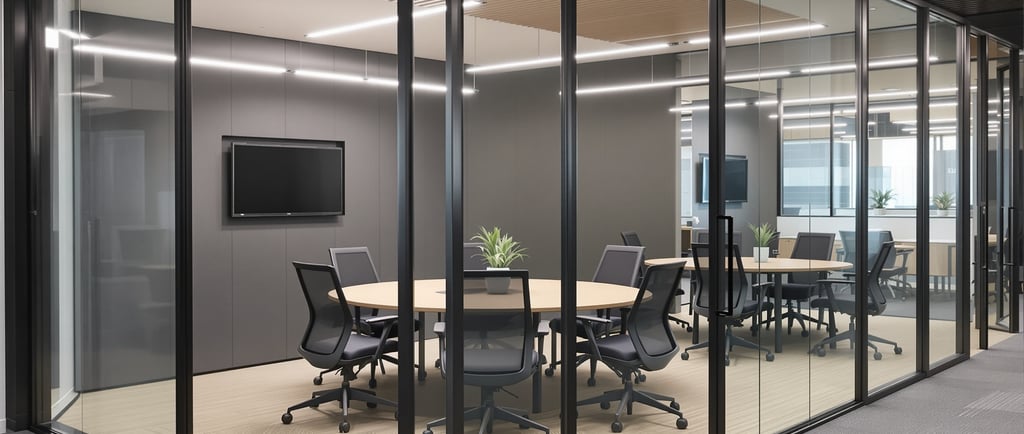
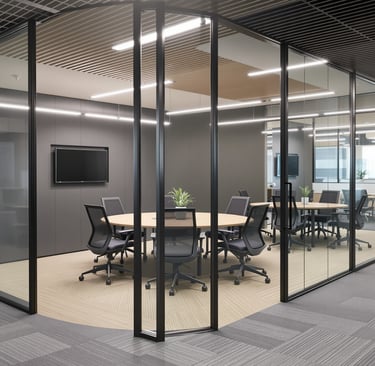
How to Balance Acoustic Privacy and Spatial Openness in Office Renovation
Practical Considerations for Hong Kong Offices
In Hong Kong, office spaces are often compact, yet expectations for privacy, focus, and professionalism continue to rise. When planning an office renovation, many companies face the same challenge: how to improve acoustic performance without sacrificing the sense of space.
This article explores practical design and construction approaches to achieving both acoustic control and spatial openness in Hong Kong office renovations.
Why Acoustic Design Matters in Office Renovation
Acoustic performance has a direct impact on productivity and daily operations.
Meeting rooms, management offices, and focus areas require sufficient sound privacy to support confidential discussions and concentrated work.
In Hong Kong office environments, acoustic issues are commonly found in:
Open-plan offices
Glass-partitioned meeting rooms
High-density commercial buildings with heavy foot traffic
For this reason, acoustic planning should be considered from the early design stage of any office renovation project.
The Importance of Maintaining a Sense of Space
While acoustic privacy is essential, excessive use of solid walls can make an office feel enclosed and restrictive. This can limit natural light penetration and reduce overall comfort for employees.
In space-constrained Hong Kong offices, spatial openness plays a key role in employee well-being and workplace perception, contributing to a more comfortable and professional environment.
Glass Partitions as a Balanced Solution
Glass partitions are widely used in office renovation projects to balance acoustic performance with visual openness.
When specified correctly—considering glass thickness, framing systems, seals, and door details—glass partitions can provide effective sound control while maintaining transparency and daylight flow.
Key benefits of glass partitions include:
Preserving natural light
Enhancing visual continuity
Creating a modern and professional appearance
Offering flexibility for future layout changes
Design and Construction Go Hand in Hand
Acoustic performance is not achieved by design alone. Construction quality plays an equally important role.
Details such as door frames, junctions between partitions and ceilings, and perimeter sealing can significantly affect sound insulation performance.
Successful office renovation projects require close coordination between design intent and on-site execution to ensure that acoustic solutions perform as intended.
Practical Design Approaches for Hong Kong Offices
Based on common site conditions in Hong Kong, the following approaches are often effective:
Replacing selected solid walls with glass partitions
Enhancing acoustic treatment in critical areas
Choosing practical, durable materials suitable for daily use
Balancing performance requirements with long-term maintenance considerations
These strategies help achieve a functional and comfortable workspace without unnecessary complexity.
Conclusion
Office renovation is more than a visual upgrade—it is a strategic investment that influences productivity, communication, and company culture.
In Hong Kong’s dense commercial environment, successful office design depends on finding the right balance between acoustic privacy and spatial openness.
With thoughtful planning and professional execution, businesses can create office environments that support both focused work and collaborative interaction.
Contact
Questions? Reach out anytime, we're here.
Phone
© 2025. All rights reserved.