
Kitchen Planning Mistakes That Increase Operating Costs
Kitchen Planning Mistakes That Increase Operating Costs
4/8/20262 min read
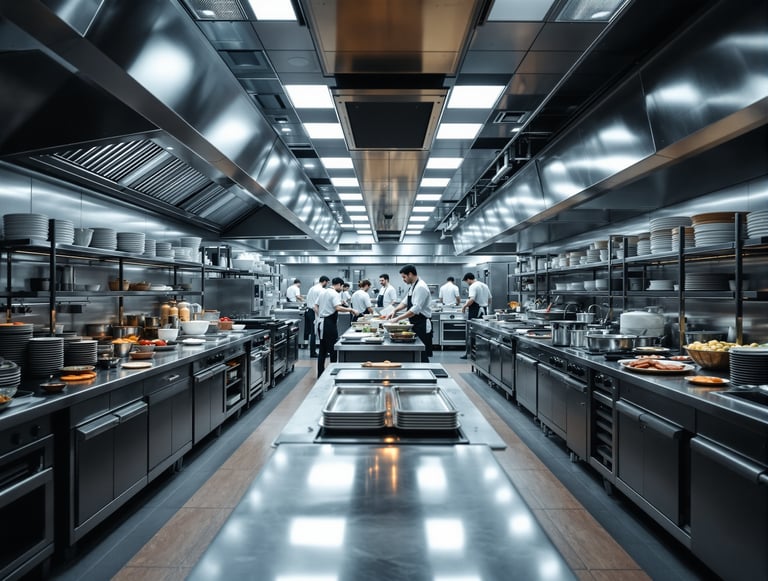
Kitchen Planning Mistakes That Increase Operating Costs
How Poor Workflow, Inefficient Prep Areas, and Equipment Mismatch Affect Restaurant Profitability
In the F&B industry, kitchen performance directly determines operational efficiency and profit margins. While many restaurant owners focus heavily on dining area aesthetics, the kitchen — where revenue is produced — is often under‑planned.
Poor kitchen planning does not only create inconvenience.
It increases labour cost, slows service, wastes energy, and reduces overall profitability.
A well‑designed kitchen is not just functional — it is a cost‑control strategy.
1. Confusing Workflow: When Movement Becomes a Bottleneck
One of the most common kitchen planning mistakes is unclear workflow.
In an efficient commercial kitchen, movement should follow a logical sequence:
Receiving → Storage → Preparation → Cooking → Plating → Service
When this flow is disrupted, problems arise:
Staff crossing paths frequently
Congestion near hot stations
Delays during peak hours
Higher risk of accidents
Every unnecessary step adds time.
Every time delay affects table turnover.
Poor workflow design increases staff fatigue and often requires more manpower to compensate for inefficiencies — directly raising labour costs.
Clear zoning between prep areas, cooking lines, washing stations, and service pass‑throughs is essential to maintaining smooth operations.
2. Inefficient Preparation Areas: Slowing Down Production
Preparation space is frequently underestimated during planning.
Common issues include:
Insufficient counter space
Poor placement of refrigeration near prep stations
Limited storage for frequently used ingredients
Shared surfaces causing operational conflicts
When prep areas are too small or poorly located, staff waste time moving between stations. During peak periods, this inefficiency multiplies.
An efficient kitchen design ensures:
Adequate prep counters based on menu complexity
Cold storage positioned near relevant prep zones
Clearly defined task areas for different kitchen roles
The goal is to reduce movement and maximise productivity per staff member.
Higher efficiency allows restaurants to maintain output without increasing headcount.
3. Equipment Mismatch: Overspending or Underperforming
Another costly mistake is selecting equipment without aligning it with operational needs.
This may result in:
Oversized equipment consuming unnecessary energy
Undersized equipment limiting production capacity
Redundant appliances occupying valuable space
Poor ventilation planning increasing utility costs
Kitchen equipment should be selected based on:
Menu requirements
Projected customer volume
Peak‑hour demand
Long‑term growth plans
For example, installing high‑capacity cooking ranges in a low‑volume café wastes both space and energy.
Conversely, under‑estimating fryer or oven demand in a fast‑casual concept creates service bottlenecks.
Equipment planning should balance performance, energy efficiency, and space optimisation.
4. The Hidden Impact on Labour and Utility Costs
Inefficient kitchen design affects more than just speed.
It can lead to:
Increased staffing requirements
Longer training time for new employees
Higher electricity and gas consumption
Greater maintenance frequency
Over time, these operational inefficiencies accumulate into significant recurring expenses.
In high‑rent cities, controlling operating cost is as important as increasing revenue.
Strategic kitchen planning reduces both.
5. Planning for Scalability and Compliance
Kitchen planning must also account for:
Food safety regulations
Fire safety requirements
Ventilation standards
Future menu expansion
Failing to anticipate these factors often results in costly retrofits.
Early coordination between designers, kitchen consultants, and engineers prevents compliance issues and protects long‑term investment.
Conclusion
A restaurant kitchen is not merely a back‑of‑house facility — it is the operational engine of the business.
Confusing workflow increases labour cost.
Inefficient prep areas slow production.
Equipment mismatch wastes space and energy.
Thoughtful kitchen planning improves:
Service speed
Staff productivity
Energy efficiency
Long‑term cost control
In the competitive F&B industry, profitability is shaped not only by sales — but by how efficiently the kitchen operates behind the scenes.
Investing in strategic kitchen planning is investing in sustainable restaurant performance.
Contact
Questions? Reach out anytime, we're here.
Phone
© 2025. All rights reserved.