
Retail Renovation Strategy in Tsuen Wan — Street-Level vs Mall Units
Retail Renovation Strategy in Tsuen Wan — Street-Level vs Mall Units
5/12/20269 min read
Retail Renovation Strategy in Tsuen Wan: Street-Level Shops vs Mall Units — What You Need to Get Right
Tsuen Wan has always been one of Hong Kong's more active retail districts. It has the foot traffic, the residential density, the transport connectivity, and the mix of local and destination shoppers that make retail viable across a wide range of formats and price points. From the busy stretches of Sai Lau Kok Road and Chung On Street to the established malls like Tsuen Wan Plaza, City Link, and Luk Yeung Galleria, there is no shortage of retail space in the district.
But not all retail space is created equal — and the renovation strategy you adopt for a street-level shop should be fundamentally different from the one you use for a unit inside a shopping mall.
This distinction matters more than most tenants realise. The wrong renovation approach does not just waste money. It can cost you time, limit your ability to attract customers, create friction with building management or government departments, and in some cases, force you to redo work that should have been done right the first time.
Whether you are opening a new shop, relocating an existing business, or refreshing a tired space, understanding the strategic and practical differences between street-level and mall-based retail renovation in Tsuen Wan is essential. Here is what you need to know.
Street-Level Shops: Your Facade Is Your Entire Marketing Strategy
Let's start with the most important thing about a street-level retail unit: your shopfront is everything.
Unlike a mall environment, where foot traffic is funnelled past your unit by the building's design and tenant mix, a street-level shop has to earn every pair of eyes that looks its way. There is no centre management team curating the customer journey for you. There is no anchor tenant drawing crowds past your door. You are competing with the entire streetscape — other shops, restaurants, signage, vehicles, pedestrians, noise — for a few seconds of attention from someone walking past.
This means your renovation strategy for a street-level shop must be front-loaded toward the exterior. The facade design, the shopfront materials, the lighting at night, the signage, and the visibility from different approach angles are not finishing touches to think about at the end of the fitout process. They are the single most important set of decisions you will make, and they should be locked in before the interior design is finalised.
In Tsuen Wan's busier retail streets, the competition for visual attention is intense. A shop with a dark, narrow entrance and a cluttered facade will lose to a competitor with a clean, well-lit, open frontage — even if the product or service inside is superior. The street does not give you the benefit of the doubt. You have to pull people in.
Practical considerations for street-level facade renovation include the width and configuration of your shopfront opening (maximising the visible interior from the pavement increases perceived accessibility), the choice of materials that remain presentable in Hong Kong's humid and polluted environment, the provision of adequate exterior lighting for evening and night-time visibility, and the integration of your signage into the overall facade composition rather than treating it as an afterthought bolted on at the last minute.
One often-overlooked factor is the condition of the canopy, the pavement immediately outside your unit, and any drainage or utility access points near the entrance. While these are not always within your control, they affect the customer's first impression of your shop. In some cases, it is worth discussing with the landlord whether improvements to the immediate exterior can be incorporated into the lease negotiation.
Mall Units: You Are Renovating Inside Someone Else's System
Now consider the mall environment. If a street-level shop is an independent house, a mall unit is an apartment inside a managed building. You own the interior, but almost everything else — the common areas, the customer flow, the operating hours, the aesthetic standards — is controlled by someone else.
This is not necessarily a disadvantage. Mall environments offer significant benefits for retailers, including built-in foot traffic from anchor tenants and complementary businesses, climate-controlled common areas, shared marketing and promotional activities, and a level of security and building maintenance that street-level shops rarely enjoy. In Tsuen Wan, malls like Tsuen Wan Plaza and City Link command strong and consistent footfall, particularly on weekends and public holidays.
But the managed nature of a mall has direct and significant implications for your renovation. Mall management companies impose detailed guidelines on what tenants can and cannot do with their units, and these guidelines cover virtually every aspect of the fitout — from the design of your storefront and the materials you use, to where you place your signage, how you handle waste during construction, and what hours your contractors are allowed to work.
If you are accustomed to renovating street-level shops, where you have relatively free rein over the design and construction process, the level of control exercised by mall management can feel restrictive. But ignoring or underestimating these requirements is a mistake. Mall management teams review and approve fitout plans before construction begins, and they will not hesitate to halt work or require modifications if the approved plans are not followed.
The approval process itself can take time. Depending on the mall, you may need to submit detailed architectural drawings, material specifications, electrical load calculations, and signage designs for review — and you may go through several rounds of revision before approval is granted. This timeline needs to be built into your project programme from the outset. Tenants who assume they can sign the lease, call the contractor, and start work the following week are setting themselves up for frustration and delay.
Renovation Timelines: The Constraint You Cannot Negotiate Away
Time is one of the most underestimated variables in retail renovation, and it plays out very differently for street-level shops and mall units.
For street-level shops in Tsuen Wan, the renovation timeline is relatively flexible. You are generally free to work during normal daytime hours, and in some cases, evening or weekend work may be possible depending on the building's management rules and the nature of the work being carried out. The primary external constraints are building management approvals for any work affecting the building structure or common areas, compliance with the Noise Control Ordinance for work that generates significant noise, and coordination with utility providers if electrical, water, or drainage upgrades are required. Beyond these, the pace of the renovation is largely within your control.
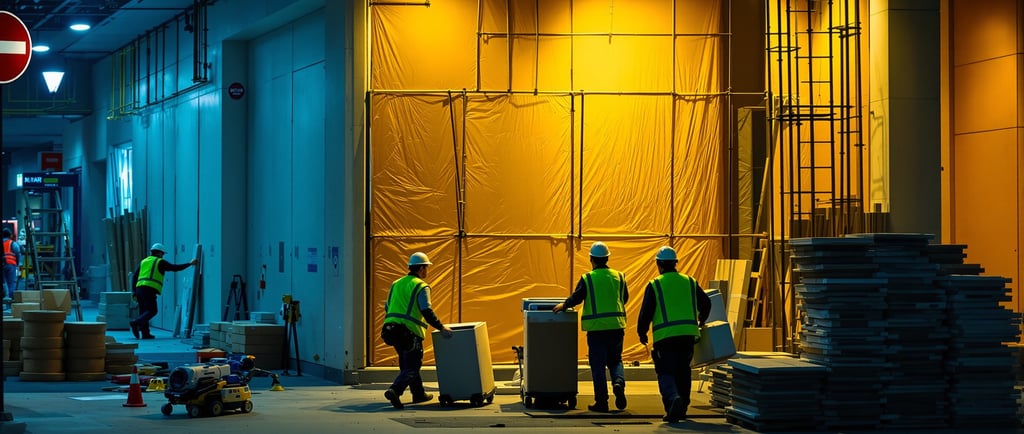
Mall units operate under a completely different regime. Most shopping centre management companies restrict renovation work to specific hours — typically late evening through early morning, after the mall has closed and before it reopens the next day. In practice, this means your contractors may only have a window of six to eight hours per night to carry out work, and they must clear the site and remove all construction debris before the mall opens to the public.
The impact on your renovation timeline is substantial. A fitout that might take three to four weeks in a street-level shop can easily take six to eight weeks or longer in a mall environment, purely because of the restricted working hours. This extended timeline has direct cost implications — longer contractor engagement, extended rent-free period requirements, delayed opening date and revenue generation — all of which need to be factored into your business plan.
There is also the question of noise and dust containment during the renovation period. Mall management will typically require hoarding to be erected around your unit during construction, and the design of the hoarding itself may be subject to approval. Some malls require tenants to use the hoarding as an opportunity for pre-opening branding, which adds a further design and production task to the project.
The practical lesson here is straightforward: if you are taking a mall unit in Tsuen Wan, do not use a street-level renovation timeline as your benchmark. Build in significantly more time, discuss the specific working hour restrictions and approval processes with mall management before you sign the lease, and ensure your contractor has experience working within mall environments. A contractor who is excellent at fitting out street-level shops may not be the right choice for a mall project if they are not accustomed to the logistical constraints.
Signage: Two Completely Different Games
Signage is where the strategic difference between street-level and mall retail becomes most visible — literally.
For a street-level shop in Tsuen Wan, signage is one of your most powerful tools for attracting customers. A well-designed, well-positioned sign can draw foot traffic from a considerable distance, particularly on busy commercial streets where pedestrians are scanning shopfronts as they walk. The size, illumination, placement, and legibility of your signage directly affect how many people notice your shop and choose to walk in.
However, street-level signage in Hong Kong is subject to regulation under the Buildings Ordinance. The Buildings Department has specific requirements regarding the size, projection, height, structural integrity, and fire safety of signs attached to buildings. Signage that does not comply with these requirements may be subject to removal orders, and in some cases, the building owner or tenant may face legal liability if a non-compliant sign causes injury or damage.
In practice, many street-level shops in older parts of Tsuen Wan have signage that predates current regulations or that was installed without formal approval. If you are renovating a unit and installing new signage, it is worth taking the time to understand what is permissible and ensuring that your sign is properly designed, safely installed, and compliant. The cost of doing this correctly is modest compared to the risk and disruption of having a sign ordered to be removed after installation.
For mall units, the signage landscape is entirely different. Mall management companies control the signage standards for the entire centre, and tenants are typically required to conform to detailed specifications regarding the size, font, colour, illumination method, and positioning of their signs. In many cases, the mall will designate a specific signage zone on the storefront fascia, and tenants are not permitted to place any branding or visual elements outside this zone.
Some malls also restrict the type of illumination permitted — for example, requiring backlit channel letters rather than externally illuminated box signs — and may specify approved signage fabricators or installation contractors. These requirements exist to maintain a cohesive visual identity across the mall, and while they can feel limiting from a tenant's perspective, they also ensure that your signage is presented in a clean and professional context rather than competing with visual clutter.
The key takeaway is that signage design should not be an afterthought in either environment. For street-level shops, it is a critical customer acquisition tool that requires careful design and regulatory compliance. For mall units, it is a branding exercise that must work within the parameters set by management. In both cases, the signage concept should be developed as part of the overall renovation design, not bolted on at the end.
Customer Flow and Interior Layout: Designing for How People Actually Move
The way customers enter, move through, and experience your shop is fundamentally different in a street-level environment compared to a mall, and your interior renovation should reflect this.
In a street-level shop, customers typically approach from one direction — the pavement — and the entrance is the single transition point between the public realm and your retail space. The design challenge is to make that transition as frictionless and inviting as possible. This means minimising barriers at the entrance, ensuring the interior is visible from outside, and placing high-impact visual merchandising or product displays within the sightline of passing pedestrians. The depth of the unit also matters. Deeper units with narrow frontages require more deliberate interior layout planning to draw customers through the space, whereas wide, shallow units benefit from a more open, browse-friendly arrangement.
In a mall environment, customers are already in a retail mindset. They are walking through a climate-controlled, well-lit corridor designed to encourage browsing. Your unit's frontage is typically fully open or glass-fronted, giving you maximum visibility. The design challenge here is less about pulling people in from outside and more about creating an interior experience that is compelling enough to stop someone mid-stride and draw them across the threshold.
Mall units also tend to have more standardised dimensions and ceiling heights, which simplifies some aspects of the renovation but also limits the degree of architectural differentiation you can achieve. In this context, materiality, lighting design, and visual merchandising become your primary tools for standing out from neighbouring tenants.
One practical consideration that applies to both environments but is particularly important in mall units is accessibility. The Disability Discrimination Ordinance and the Design Manual for Barrier Free Access set out requirements for accessible retail premises, including entrance widths, ramp provisions, and counter heights. Mall management companies will typically enforce these requirements as part of the fitout approval process, and non-compliance can result in the need for costly post-completion modifications.
Choosing the Right Format for Your Business in Tsuen Wan
Ultimately, the decision between a street-level shop and a mall unit in Tsuen Wan is not just about rent or availability. It is a strategic choice that affects your renovation budget, your timeline, your signage and branding options, your operating flexibility, and your relationship with foot traffic.
Street-level shops offer greater creative freedom, more control over your renovation timeline, and the ability to create a distinctive, standalone identity. But they demand more effort in attracting foot traffic, more responsibility for building maintenance and compliance, and more exposure to the unpredictability of the streetscape.
Mall units offer built-in customer flow, a managed and climate-controlled environment, and the credibility that comes with being part of an established retail destination. But they come with management restrictions, longer and more constrained renovation timelines, and less flexibility in signage and design.
Neither option is inherently better. The right choice depends on your business model, your target customer, your budget, and your appetite for managing the renovation process. What matters most is that your renovation strategy matches the format you have chosen — because the mistakes that cost the most in retail are not the ones you make inside the shop. They are the ones you make before the shop even opens.
In retail renovation, the strategy comes before the contractor. Get the strategy right, and everything else follows.
Contact
Questions? Reach out anytime, we're here.
Phone
© 2025. All rights reserved.