
Space Optimisation in Compact Tsuen Wan Commercial Units — Making Every Square Foot Work Harder
Space Optimisation in Compact Tsuen Wan Commercial Units — Making Every Square Foot Work Harder
5/19/202614 min read
Introduction: The Space Reality in Tsuen Wan
Tsuen Wan is one of the most commercially active districts in Hong Kong's New Territories, offering a genuine range of property formats — from industrial buildings and street-level shops to modern mall units and mixed-use podium spaces. For tenants, this diversity means options. But it also means confronting a reality that cuts across almost every format: the units are compact.
This is not unique to Tsuen Wan — small commercial units are a defining characteristic of Hong Kong's property landscape. But in Tsuen Wan, the issue is particularly pronounced. Much of the district's commercial building stock was developed during the 1970s and 1980s, an era when unit planning prioritised subdivision efficiency over generous floor plates. Street-level shops in older walk-up buildings commonly range from 200 to 500 square feet. Industrial building units, while sometimes larger in gross area, often lose significant usable space to structural columns, irregular layouts, and thick perimeter walls. Even mall units in newer developments tend to be tightly planned, with standard retail bays frequently falling below 400 square feet.
For business operators — whether running a retail shop, a food and beverage outlet, a service-based business, or a studio — the challenge is the same: how to fit all necessary functions into a space that feels too small, without creating an environment that looks cramped, operates inefficiently, or compromises the customer experience.
The answer is not to find a bigger unit. In Tsuen Wan's market, bigger units come with proportionally higher rent, and for many small to medium businesses, the budget simply does not stretch that far. The answer is to design the space more intelligently — to make every square foot perform more than one function, to recover space that would otherwise be wasted, and to create the perception of openness even within tight physical constraints.
This blog explores four core strategies for achieving that: loft and mezzanine design, storage integration, circulation compression, and multi-purpose spatial planning. Each strategy is discussed in the context of Tsuen Wan's specific building conditions, because space optimisation is not an abstract design exercise — it is a response to real structural, regulatory, and operational constraints that vary by building type.
Understanding What You Are Working With
Before any design strategy can be applied, the starting point must be an honest assessment of the unit's physical parameters. In Tsuen Wan, the typical constraints include the following.
Ceiling height is the single most important dimension for space optimisation, because it determines whether vertical strategies — lofts, mezzanines, elevated storage — are feasible. Street-level shops in older buildings typically offer slab-to-slab heights of around 3 to 3.5 metres, which is workable but tight. Industrial buildings from the 1970s and 1980s often provide more generous heights, sometimes 3.5 to 4.5 metres or more, which opens up significant vertical potential. Mall units vary, but are frequently constrained to around 3 metres or less after accounting for the ceiling void required for building services.
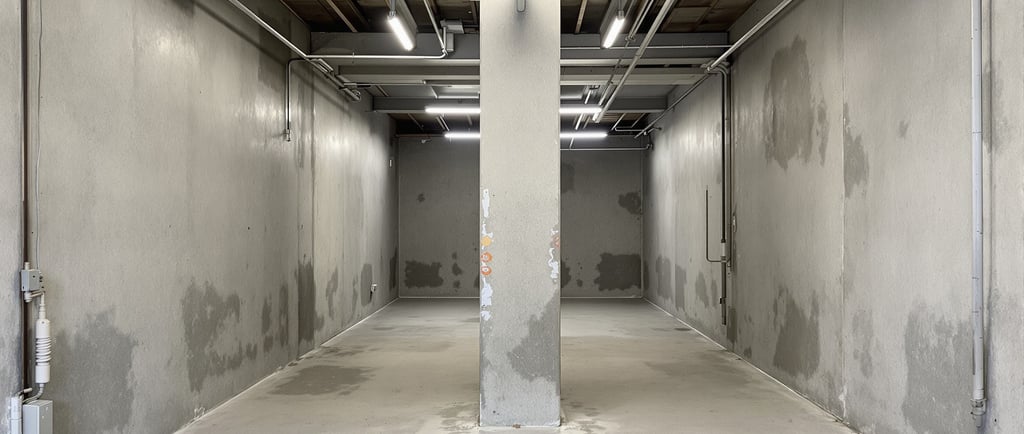
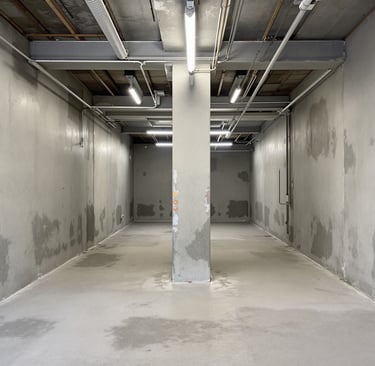
Structural columns and beams are a defining feature of older Tsuen Wan buildings. Many were built using reinforced concrete frame construction with columns positioned at regular intervals within the floor plate. These columns cannot be removed and often appear in inconvenient locations — near the centre of a unit, close to the entrance, or at points that disrupt an otherwise regular layout. Effective space design must work with these columns, incorporating them into shelving systems, partition walls, or visual features rather than treating them as obstacles to work around.
Unit depth and proportion affect how a space feels and how circulation works within it. Many street-level shops in Tsuen Wan are narrow and deep — sometimes only 3 to 4 metres wide but 10 to 15 metres deep. This proportion creates a tunnel effect and makes the rear portion of the unit feel disconnected from the shopfront. Industrial units tend to be more regular in proportion but may have odd angles or setbacks where the building footprint follows an irregular site boundary.
Building services and access points further constrain the usable layout. The locations of water supply, drainage, electrical distribution boards, and ventilation risers are typically fixed and expensive to relocate. In older Tsuen Wan buildings, these services may be positioned in ways that conflict with an optimal layout, and any design must account for their presence.
Understanding these parameters before beginning the design process is essential. Space optimisation strategies that work brilliantly in a new-build commercial unit with 3.5-metre ceilings and a regular floor plate may be completely impractical in a 1970s Tsuen Wan walk-up with 2.8-metre ceilings and a column in the middle of the shop.
Strategy One: Loft and Mezzanine Design
Of all the space optimisation strategies available to tenants in compact Tsuen Wan units, the addition of a loft or mezzanine level offers the most dramatic increase in usable area. A well-designed mezzanine can add 30 to 50 percent to the functional floor area of a unit without increasing the leased footprint or the rent.
However, mezzanine design in Tsuen Wan is subject to significant practical and regulatory constraints that must be understood from the outset.
When a mezzanine is feasible. The most basic requirement is sufficient ceiling height. As a general guideline, a functional mezzanine requires a minimum slab-to-slab height of approximately 4.2 to 4.5 metres to allow adequate headroom on both the ground level and the mezzanine level, accounting for the structural depth of the mezzanine platform itself. In practice, this means mezzanines are most commonly viable in industrial building units, where original ceiling heights were designed to accommodate manufacturing and storage activities. Street-level shops and mall units in Tsuen Wan rarely have sufficient height unless the building was specifically designed with double-height ground floor retail in mind.
Regulatory considerations. Under Hong Kong's Buildings Ordinance, a mezzanine that exceeds a certain proportion of the floor area below it, or that is enclosed in a way that constitutes an additional storey, may be classified as a building addition requiring prior approval from the Buildings Department. Unauthorised mezzanines — sometimes referred to as illegal structures — are a compliance risk for both the tenant and the landlord. The distinction between a permitted internal loft and an unauthorised building addition is technical, and professional advice from an authorised person or registered structural engineer should be sought before committing to this strategy. For industrial building units where mezzanines are common, tenants should verify whether an existing mezzanine was properly approved, as inheriting an unauthorised structure creates liability.
Structural requirements. A mezzanine is a structural addition. It must be designed to carry the intended load — which varies significantly depending on whether the mezzanine is used for storage, as a workspace, or as a customer-facing area. The supporting structure, typically steel, must be designed by a qualified engineer and must connect to the building's existing floor slab without compromising its structural integrity. In older Tsuen Wan industrial buildings, the condition of the existing slab should be assessed before additional loads are applied.
Practical design considerations. Beyond the structural and regulatory requirements, the effectiveness of a mezzanine depends on several design decisions. Access is critical — a fixed staircase provides the safest and most functional access but consumes floor area, while a vertical ladder saves space but is unsuitable for frequent use or customer access. The position of the mezzanine within the unit should be considered carefully: placing it at the rear of a deep unit keeps the main frontage open and maintains visual volume at the entrance, which is important for retail environments. Balustrade design affects both safety and the sense of openness — solid balustrades provide privacy for the mezzanine level but make the ground floor feel more enclosed, while open or glass balustrades maintain visual continuity.
Best applications in Tsuen Wan. Mezzanines work particularly well in industrial building units being used as studios, co-working spaces, showrooms, or retail operations where back-of-house functions such as storage and office work can be elevated to the upper level, freeing the ground level entirely for customer-facing activity. In some food and beverage applications, a mezzanine can provide additional seating, though this introduces additional regulatory requirements around means of escape and fire safety.
Strategy Two: Storage Integration
In compact commercial units, storage is the function that most commonly cannibalises usable space. A 300-square-foot retail shop that dedicates 80 square feet to a back storeroom has effectively reduced its selling floor by more than 25 percent. In a food and beverage unit, the proportion lost to dry storage, cleaning supplies, and equipment can be even higher. For service businesses — beauty salons, clinics, tutorial centres — the accumulation of supplies, consumables, and personal items for staff creates ongoing storage pressure that tends to grow over time.
The solution is not to eliminate storage — every business needs it — but to integrate it into the architecture of the space so that it does not require dedicated floor area.
Vertical storage systems. In units with ceiling heights of 3 metres or more, the zone above 2.1 metres — the typical reach height for most people — represents recoverable space. Wall-mounted shelving, overhead cabinets, and ceiling-hung racks can store infrequently accessed items such as seasonal stock, spare equipment, packaging materials, and archival documents without using any floor area at all. In industrial units with higher ceilings, this vertical zone is even more substantial and can accommodate heavy-duty racking systems for significant storage volume.
Perimeter integration. Rather than concentrating storage in a single storeroom, effective design distributes storage around the perimeter of the unit, built into walls, under counters, within seating platforms, and inside display fixtures. A retail display wall that incorporates enclosed storage behind or below the display zone serves two functions in the footprint of one. A reception counter with built-in shelving and drawers eliminates the need for a separate back-office storage cabinet. A window bench in a café that opens to reveal storage below serves simultaneously as seating, atmosphere, and stockroom.
Concealed and flush storage. In compact units where visual clutter is the enemy of perceived spaciousness, storage elements should be designed to disappear when not in use. Full-height cabinets with flush, handle-free doors read as walls rather than storage. Recessed shelving within partition walls uses the thickness of the wall itself as storage depth without projecting into the room. Floor platforms with lift-up panels provide storage beneath the walking surface — a technique borrowed from Japanese residential design that works equally well in small commercial settings.
Zone-specific storage. Rather than designing a general-purpose storeroom, a more space-efficient approach is to locate storage at the point of use. Kitchen utensils stored within arm's reach of the preparation area. Retail stock stored directly behind or below the relevant display. Cleaning supplies stored in a narrow vertical closet near the washroom rather than in a central storeroom accessed via the main floor. This approach reduces the need for movement between work zones and storage zones, which has the secondary benefit of improving operational efficiency in a small space.
Storage in Tsuen Wan's older buildings. In street-level shops within older walk-up buildings, the presence of structural columns, exposed risers, and irregular wall setbacks often creates small pockets of space that are too awkward for primary use but perfectly adequate for built-in storage. A shallow recess next to a drainage riser can become a narrow shelving unit. The space behind a column can be enclosed to create a small storage cabinet. Effective space design in these buildings requires identifying and harvesting every such pocket rather than accepting them as dead space.
Strategy Three: Circulation Compression
Circulation — the space people move through to get from one part of a unit to another — is the most underestimated consumer of floor area in compact commercial spaces. In a generously sized unit, generous corridors and wide pathways between zones contribute to a sense of comfort and flow. In a 300-square-foot unit, the same approach can mean that 30 to 40 percent of the floor area serves no function other than movement, leaving a diminished area for the activities that actually generate revenue.
Circulation compression is the practice of reducing the floor area dedicated to movement without making the space feel cramped or obstructing operational flow.
Eliminating dedicated corridors. In compact units, the traditional layout of a corridor connecting separate rooms is one of the least efficient uses of space. A 1.2-metre-wide corridor running 4 metres from front to back consumes almost 5 square metres — roughly 50 square feet — for the sole purpose of walking. In most small commercial applications, this can be eliminated entirely by adopting an open-plan layout where movement happens through the functional zones themselves rather than alongside them. A customer walking through a retail display area is simultaneously browsing and circulating. A staff member moving through an open kitchen is simultaneously working and circulating. The circulation is embedded in the activity rather than separated from it.
Reducing aisle widths to operational minimums. Hong Kong's fire safety regulations and accessibility requirements set minimum clear widths for means of escape and public access, and these must be respected. But within those minimums, there is often scope to reduce aisle widths below what tenants instinctively allocate. A retail aisle does not need to be 1.5 metres wide if 1.0 metre provides comfortable passage for one person and compliance with fire safety requirements. A service counter does not need a 1.2-metre staff zone behind it if 0.8 metres allows the operator to work comfortably. Each 200 millimetres saved across the width of a unit, multiplied by the length of the unit, recovers meaningful floor area.
Front-to-back zoning. In narrow, deep units — the dominant proportion for Tsuen Wan street-level shops — the most efficient circulation model is a single linear flow from front to back, with public-facing functions at the front, transitional functions in the middle, and back-of-house functions at the rear. This eliminates the need for lateral corridors and allows the full width of the unit to be used at every point along its depth. Customer flow follows a natural path from entry to service to exit without requiring space for direction changes, passing lanes, or waiting areas.
Shared circulation zones. Where different functions must coexist in a compact unit, designing circulation to serve multiple zones simultaneously is more efficient than providing separate access to each. A single pathway that serves as both the customer approach to a service counter and the staff route to a preparation area avoids duplicating circulation space. This requires careful planning to avoid operational conflicts — customers and staff moving through the same space at the same time must not obstruct each other — but when executed well, it can save significant floor area.
Circulation in Tsuen Wan industrial units. Industrial building units often have their entrance point at one corner or one side, with the remainder of the unit being a large open rectangle. This is inherently efficient for circulation because there is minimal need for corridors — the entire floor plate is accessible from any point. The risk, however, is that tenants introduce unnecessary partition walls to create separate rooms, which then require corridors to connect them, eroding the very spatial efficiency that makes the open plan advantageous. Where partitioning is necessary, partial-height partitions, glass partitions, or curtain dividers maintain the sense of openness while providing functional separation.
Strategy Four: Multi-Purpose Space Design
The most powerful space optimisation strategy for compact Tsuen Wan units is also the most conceptually simple: design spaces that serve more than one purpose.
In a large unit, it is natural and appropriate to dedicate specific areas to specific functions — a meeting room is a meeting room, a storeroom is a storeroom, a reception area is a reception area. In a compact unit, this approach is a luxury that the available floor area cannot support. Every square foot that serves only one function represents a missed opportunity to extract more value from the space.
Convertible furniture and fixtures. The most immediate application of multi-purpose design is furniture and fixtures that transform between functions. A wall-mounted folding table that serves as a workspace during business hours and folds flat against the wall after hours to clear floor space for a different activity. A display counter on castors that can be repositioned to create a demonstration area, a queuing lane, or an open event space depending on the day's requirements. Seating that incorporates storage. A service counter that doubles as a product display. These are not novel concepts, but their disciplined application in a compact commercial setting can significantly increase the functional capacity of the space.
Time-based space sharing. Not all functions within a business operate simultaneously. A tutorial centre may use its main room for classes during the afternoon and evening but needs administrative workspace during the morning. A restaurant may need maximum seating during meal periods but could use part of the dining area as a preparation zone during off-peak hours. Designing the space to accommodate these temporal shifts — through moveable partitions, stackable furniture, reconfigurable layouts — allows the same floor area to serve different functions at different times, effectively multiplying the usable area without expanding the physical footprint.
Dual-function zones. Some spatial overlaps are permanent rather than time-based. A window display zone that also functions as customer seating — common in cafés where window-facing bars serve both as the primary visual frontage from the street and as the seating area. A fitting room in a retail shop that doubles as a consultation space for personal styling appointments. A reception area that incorporates a product showcase, so that the space customers occupy while waiting is simultaneously performing a marketing function. Each of these examples eliminates a zone that would otherwise need to exist separately.
Staff and back-of-house compression. In many compact Tsuen Wan units, the greatest space savings come not from the customer-facing area but from the back-of-house. Staff changing areas, break rooms, manager offices, and administrative spaces are all legitimate operational needs, but in a unit below 500 square feet, dedicating separate rooms to each is not feasible. Combining the staff break area with the storage zone, integrating the office function into the service counter area, and using vertical space for staff lockers rather than a changing room are all strategies that compress back-of-house functions into a fraction of the floor area that a conventional layout would require.
Multi-purpose design in different Tsuen Wan formats. The application varies by building type. In industrial units, where the ceiling height and open floor plate provide maximum flexibility, multi-purpose design often involves creating a single large open space that can be reconfigured for different events, client meetings, production runs, or retail pop-ups. In street-level shops, where the narrow width constrains reconfiguration, multi-purpose design focuses more on fixed dual-function elements — display-storage hybrids, counter-workspace combinations, seating-storage integrations. In mall units, where the fitout must conform to management standards and the facade design is often fixed, multi-purpose strategies tend to focus on the interior layout, particularly the relationship between selling floor and stockroom.
Bringing It All Together: A Practical Framework
These four strategies — loft design, storage integration, circulation compression, and multi-purpose planning — are not independent options to be selected individually. The most effective space optimisation in compact Tsuen Wan units comes from applying all four simultaneously, as an integrated design approach.
Consider a 350-square-foot street-level shop in a 1970s Tsuen Wan walk-up, intended for use as a specialty retail operation. A conventional layout might allocate 200 square feet to the selling floor, 80 square feet to a back storeroom, 40 square feet to a corridor connecting the two, and 30 square feet to a small service counter area. The selling floor — the only area generating revenue — represents just 57 percent of the total.
An optimised approach to the same unit might eliminate the dedicated storeroom by integrating storage into the perimeter display fixtures and utilising the vertical zone above 2.1 metres for overhead stock. The corridor disappears because the selling floor and the service zone merge into a single open-plan space with a linear front-to-back flow. The service counter doubles as a wrapping station, a display element, and an administrative workspace. The result is a selling floor that occupies 85 to 90 percent of the unit — a transformation achieved not by expanding the unit but by designing it differently.
The same principle applies across all formats and business types. The specific solutions vary — a café has different operational requirements than a tutorial centre, and an industrial unit presents different structural opportunities than a mall unit — but the underlying discipline is the same. Every element in the space must earn its footprint by serving at least one primary function, and wherever possible, a secondary function as well. Dedicated single-function spaces should be minimised. Circulation should be embedded in activity. And the vertical dimension should be exploited wherever ceiling height allows.
Working With Tsuen Wan's Constraints, Not Against Them
Tsuen Wan's compact commercial units are a constraint, but they are not a disadvantage — provided the design response is proportionate to the challenge. Hong Kong tenants and business operators have long demonstrated extraordinary creativity in making small spaces work, and Tsuen Wan's diverse building stock provides a genuine range of spatial opportunities for those willing to look beyond the headline square footage.
The key is to approach space optimisation as a design discipline, not an afterthought. It begins before the lease is signed, by selecting a unit whose physical parameters — ceiling height, column positions, unit proportion, services locations — are compatible with the intended use. It continues through the design phase, where every layout decision should be tested against the question of whether each square foot is working as hard as it can. And it extends into the construction phase, where precision in joinery, built-in furniture, and fixture integration makes the difference between a space that feels intentionally compact and one that feels simply small.
For tenants planning a commercial renovation in Tsuen Wan, space is the resource you cannot buy more of. The rent is fixed, the walls are fixed, the columns are fixed. What is not fixed is how intelligently the space between them is used.
Contact
Questions? Reach out anytime, we're here.
Phone
© 2025. All rights reserved.