
Space Planning Tips for Small Hong Kong Offices
Space Planning Tips for Small Hong Kong Offices
2/18/20262 min read
Space Planning Tips for Small Hong Kong Offices
Office space in Hong Kong is often compact, making effective space planning essential. A well‑planned small office can support productivity, collaboration, and employee comfort without feeling overcrowded.
With the right strategies, limited floor area can be transformed into a functional and efficient workplace that meets both current and future needs.
1. Start with a Clear Understanding of Needs
Before planning the layout, it is important to understand how the office is actually used.
Consider:
Number of staff and future growth
Work styles (focused work, collaboration, meetings)
Storage and equipment requirements
A clear brief helps avoid wasted space and unnecessary design changes later.
2. Prioritise Flexible Layouts
Flexibility is key in small offices. Fixed layouts can quickly become inefficient as teams grow or change.
Effective solutions include:
Modular furniture systems
Reconfigurable workstations
Multi‑purpose areas that serve more than one function
Flexible planning allows the office to adapt without major renovation.
3. Use Space Zoning Instead of Full Partitions
Instead of enclosing areas with solid walls, zoning can define different functions while maintaining openness.
Zoning methods include:
Furniture arrangement
Changes in flooring or ceiling treatment
Lighting variations
This approach helps maintain visual continuity and improves space efficiency.
4. Maximise Natural Light and Transparency
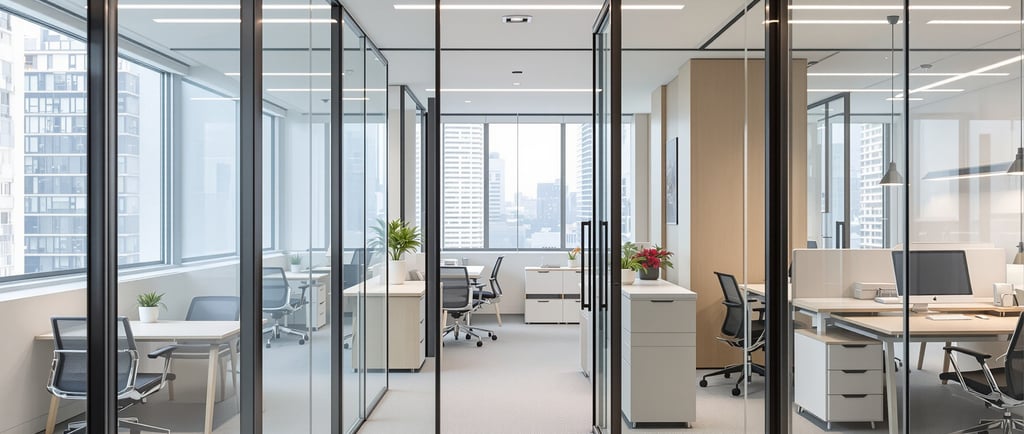
Natural light makes small spaces feel larger and more comfortable. Where partitions are required, transparent or semi‑transparent materials are recommended.
Design strategies:
Glass partitions instead of solid walls
Low‑height storage to avoid blocking light
Light‑coloured finishes to reflect daylight
Improved daylight also contributes to employee well‑being.
5. Plan Storage Carefully
In compact offices, storage should be integrated into the design rather than added as an afterthought.
Smart storage solutions include:
Built‑in cabinetry
Vertical storage systems
Under‑desk or shared storage
Well‑planned storage keeps the workspace organised and clutter‑free.
6. Address Acoustic Comfort Early
Noise can be a major issue in small offices, especially open‑plan layouts.
Effective acoustic planning may include:
Acoustic ceiling panels
Sound‑absorbing wall finishes
Soft furnishings or acoustic screens
Managing sound levels improves concentration without sacrificing openness.
7. Consider Shared and Multi‑Functional Spaces
Meeting rooms, break areas, and collaboration spaces can often be shared or combined.
Examples include:
Meeting rooms doubling as training spaces
Informal collaboration areas replacing large conference rooms
Multi‑functional spaces maximise usage without increasing floor area.
8. Plan for Building Constraints
Many Hong Kong office buildings have fixed elements such as columns, ceiling heights, and service locations.
Early coordination helps to:
Integrate building services efficiently
Avoid layout conflicts
Reduce construction adjustments
Understanding these constraints early saves time and cost.
Conclusion
Space planning for small Hong Kong offices requires thoughtful design, flexibility, and efficient use of every square metre. By focusing on functionality, light, storage, and adaptability, even compact offices can provide a comfortable and productive working environment.
With proper planning and professional execution, small offices can work smarter—without feeling small.
Contact
Questions? Reach out anytime, we're here.
Phone
© 2025. All rights reserved.