
Why Tsuen Wan Is Becoming a Secondary Commercial Hub
Why Tsuen Wan Is Becoming a Secondary Commercial Hub
5/5/20264 min read
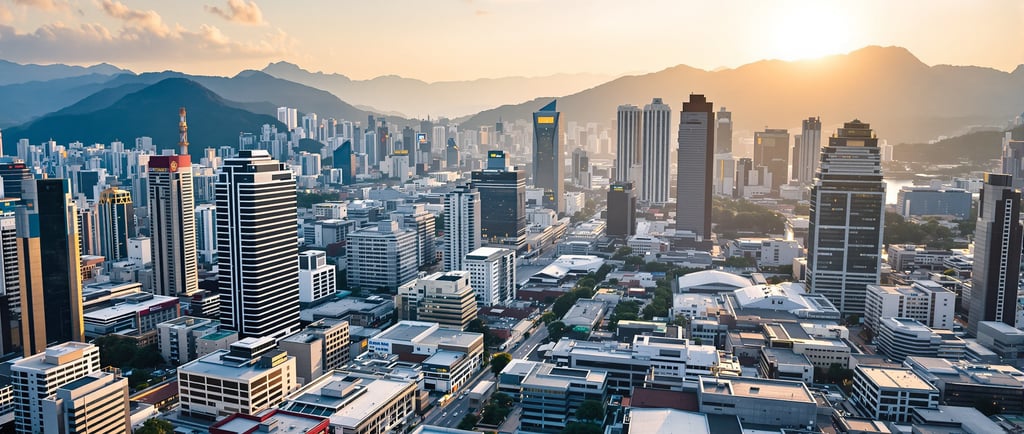
Why Tsuen Wan Is Becoming Hong Kong's Next Secondary Commercial Hub
For years, the conversation around commercial real estate in Hong Kong has been dominated by the usual suspects — Central, Tsim Sha Tsui, Kwun Tong, and Kowloon East. But if you've been paying close attention to where businesses are actually setting up shop in 2025 and 2026, one district keeps showing up on the radar: Tsuen Wan.
What was once considered a predominantly residential and industrial neighbourhood on the western edge of the New Territories is now evolving into something far more dynamic. Tsuen Wan is quietly establishing itself as a credible secondary commercial hub, and the shift is being driven by a combination of economics, infrastructure, policy, and entrepreneurial energy that's hard to ignore.
Let's break down what's fuelling this transformation.
The Rental Advantage Is Real — And It's Significant
Let's start with the most obvious driver: cost.
Prime office rents in Central continue to hover at levels that are simply out of reach for the vast majority of SMEs, startups, and growing businesses. Even traditionally "affordable" alternatives like Kwun Tong and Cheung Sha Wan have seen steady rental increases as demand spills over from core commercial districts.
Tsuen Wan, by comparison, offers a compelling value proposition. Grade B and Grade C office space in the district can come in at a fraction of what you'd pay in Kowloon East, let alone Hong Kong Island. For a startup founder trying to keep burn rate low, or an established SME looking to expand without overcommitting on overheads, the arithmetic is straightforward. You get more usable space, more flexibility in lease terms, and more room to breathe financially.
This isn't just about being "cheap." It's about being strategically affordable. The savings on rent can be redirected into hiring, marketing, inventory, or product development — the things that actually grow a business. Smart operators understand this, and they're voting with their feet.
Industrial Building Revitalisation Is Reshaping the Landscape
One of the most transformative forces in Tsuen Wan's evolution has been the ongoing revitalisation of its industrial buildings. The district has one of the highest concentrations of industrial stock in Hong Kong, and under successive government policies encouraging conversion and redevelopment, many of these ageing factory buildings are being given entirely new identities.
Walk through areas around Chai Wan Kok or along Texaco Road today, and you'll find former manufacturing floors that have been converted into co-working spaces, creative studios, e-commerce fulfilment centres, digital media offices, and even food production facilities with modern fitouts. The revitalised units often feature open-plan layouts, higher ceilings, and a raw aesthetic that appeals to younger businesses and creative industries.
This wave of conversion has effectively expanded the commercial inventory in Tsuen Wan without requiring entirely new developments. It has also attracted a diverse tenant mix — from logistics operators and trading companies to YouTubers, designers, and tech startups — creating a more textured and interesting business ecosystem than what you'd find in a typical single-purpose commercial tower.
Connectivity That Punches Above Its Weight
Location matters, but connectivity matters more. And on this front, Tsuen Wan delivers.
The district sits at a genuine transport crossroads. The MTR Tsuen Wan Line has been the backbone of the area's accessibility for decades, providing a direct connection to Kowloon and Hong Kong Island. But the addition of the Tsuen Wan West Station on the West Rail Line (now part of the Tuen Ma Line) has been a game-changer, linking the district seamlessly to the northwestern New Territories, Kowloon, and beyond.
For businesses that need to move people or goods across the city, the dual-line coverage is a major practical advantage. Employees commuting from Yuen Long, Tin Shui Wai, or Tuen Mun can reach Tsuen Wan efficiently. So can clients or partners based on the Kowloon side. The district is also well-served by bus networks and is close to the Tsing Ma Bridge corridor, offering convenient access to the airport and Lantau.
In a city where commute time directly affects talent recruitment and retention, Tsuen Wan's transport connectivity makes it a realistic option for businesses that might previously have felt tethered to more central locations.
A Growing Concentration of Entrepreneurs and Small Businesses
Perhaps the most telling sign of Tsuen Wan's emergence as a commercial hub is the type of people who are choosing to base themselves there.
Over the past few years, there has been a noticeable clustering of entrepreneurs, small business owners, and independent operators in the district. This isn't accidental. The combination of affordable rents, flexible industrial and commercial spaces, and good transport links creates exactly the kind of environment that early-stage and growing businesses need.
Co-working spaces and shared offices in Tsuen Wan have been doing steady business, often attracting tenants who tried more central locations first and found the cost-to-value ratio unsustainable. You'll also find a growing number of e-commerce brands running their entire operations — from office administration to warehousing and dispatch — within a single Tsuen Wan industrial unit, something that would be logistically impossible or prohibitively expensive in a conventional office district.
This concentration of entrepreneurial activity creates a positive feedback loop. As more businesses move in, the surrounding ecosystem develops to support them: more food and beverage options, better building management, more service providers, and a growing sense of commercial identity for the neighbourhood. Tsuen Wan is increasingly a place where serious business gets done, not just a place where people sleep before commuting elsewhere.
What This Means Going Forward
Tsuen Wan is not going to replace Central or Kowloon East as a primary commercial district — and it doesn't need to. Its strength lies in offering a viable, practical alternative for the broad base of Hong Kong's business community that doesn't require a prestigious address but does require functional, well-connected, and affordable space.
As the city's commercial geography continues to decentralise, districts like Tsuen Wan that combine transport infrastructure, evolving building stock, and a critical mass of business activity are well-positioned to capture a growing share of demand. For landlords, investors, and tenants alike, the district deserves serious attention.
If you're considering a move to Tsuen Wan or exploring commercial opportunities in the area, it pays to work with someone who understands the local market at a granular level — from which buildings offer the best value to where the next wave of revitalisation is likely to hit.
The smart money isn't always in the most expensive postcode. Sometimes, it's in the one that's about to arrive.
Contact
Questions? Reach out anytime, we're here.
Phone
© 2025. All rights reserved.